The world of intellectual property law is quite relevant to musicians, especially DJs and producers that sample other people’s material in performance and composition. In this article, we provide some general tips for navigating this confusing, potentially treacherous landscape, so read on as we explain the basics behind laws that apply when remixing in your bedroom or playing a mashup routine live.

Please be aware that this article is written from the perspective of United States law. The spirit of most other national copyright laws is similar that of the U.S, but there are often important differences.

The Basics of Copyright

A copyright is an exclusive right, granted by the government, to the author of a particular work. This includes (among other things) the right to copy and distribute the work, the right to be credited for the work, and the right to determine who may publicly perform, adapt, or benefit financially from the work. For the purposes of this article, you can think of a “work” as a song. However, the copyright to a musical composition covers not just the final mix, but  all of the original stems in a master recording as well!

There are two “sides” to music copyrights: a master side and a publishing side. I’ll go into greater detail later, but for now it’s enough to know that the master side covers the sound recording (and every stem used in the mix of that sound recording), while the publishing side covers the underlying composition (the music and lyrics upon which the sound recording is based).

“Infringement” is the legal term for violating someone else’s copyright.

This might take the form of (among other things)

  • illegally copying or distributing a song
  • failing to give proper credit to the owner of a song
  • playing, remixing or financially exploiting a song without proper permission.

The implications of all of this may come as a surprise, but before you faint with concern that your next gig will be in the prison yard, take a deep breath. Unless you’re running PirateBay, MegaUpload, TorrentVortex or another nefariously-named haven of content theft, it’s unlikely that you’ll be making new friends behind bars (at least as a result of your musical endeavors). However, if you want to:

  1. avoid being sued for copyright infringement
  2. make as much money as possible from your own originals and remixes

Then continue reading for tips to help you navigate and take advantage of copyright law!

Production

If you write and produce music, you probably already know that registering a copyright in the States is pretty easy. You fill out a form at copyright.gov, pay $40, and send two hard copies of your work to the U.S. Copyright Office.
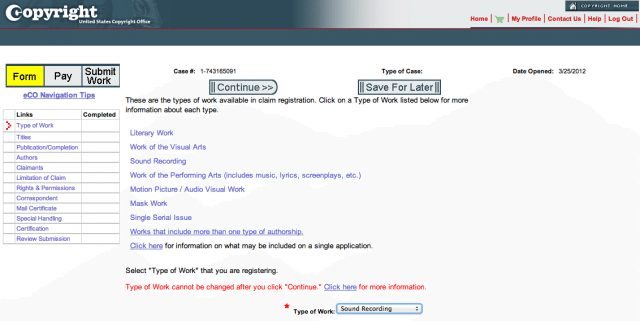
Filing online at Copyright.Gov will remind you that government is often 5-10 years behind in web design.

In typical government fashion, it takes the bastards between four months and four years to make things official, but your copyright will run from the date they receive your application. I’d strongly recommend doing this for any original music you produce. Also, be aware that master and publishing copyrights are registered separately.

Official Remixes
Using and protecting music that you create from scratch is a bit of a no-brainer. Remixes are more complex. Legally speaking, a remix is a “derivative work”; that is a new work based upon an original work. According to the letter of the law, you need permission from the copyright holder of the original work in order to create a derivative work.

If an artist or label sends you a song to remix, that probably constitutes sufficient permission to create a derivative work (though it’s a good idea to at least have some written record of that permission – even it it’s just an e-mail). What an official remix opportunity like this doesn’t always do is determine who will own the resulting remix.

As mentioned, the master side of a copyright covers every stem in the mix, and the publishing side covers the lyrics and music. Since your resulting remix is likely to be comprised of stems, lyrics and music from the original combined with new stems and new music written by you (or a third party), the resulting ownership breakdown is by no means obvious.
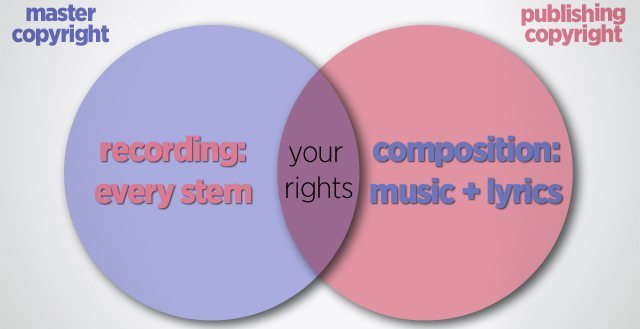
Your Rights When Making A Remix


Many artists/labels will address this complication by paying you a flat fee in exchange for your release of all rights to the remix. That saves a considerable accounting headache for the label and these days may be as much as you’re ever likely to see from royalties anyway.

Be aware that these sorts of issues are negotiable.

You can and should discuss copyright issues with the owner of the original song. By doing an official remix, you’ve written at least part of a new song, which means that you’re entitled to a proportional part of the publishing side of the new copyright. If you’re not being paid anything up front, that’s all the more reason to ask for this.

If you’ve produced original stems that went into the remix, you theoretically own part of the new master also. The problem here is, if an artist/label releases your remix as part of an album or EP, adding you to their accounting program and paying you a fractional royalty percentage will be very annoying (and it’s something many smaller labels are just not equipped to do). Paying percentages on the publishing side of a copyright is less of a headache for labels because performance-rights organizations like ASCAP, BMI and SESAC do most of the dirty work. Just make sure you register with them if and when you do receive a songwriting credit, otherwise they feed your royalty to Marc Anthony.

Copyright When Playing Out
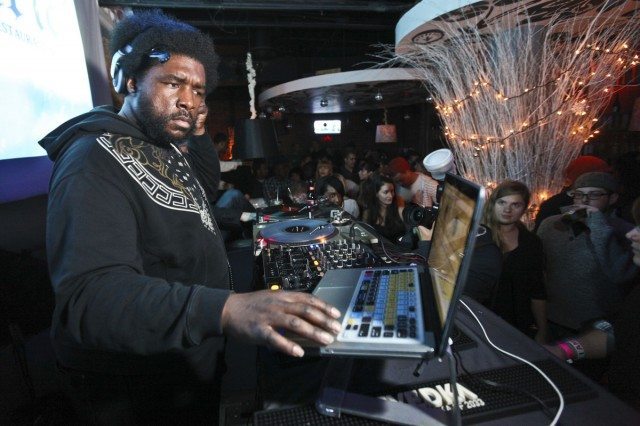
Photo Credit: Aram Boghosian for The Boston Globe

Live performance is a different story altogether. If the songs you play are your own, there’s likely nothing to worry about. With most DJs, unless you’re Daft Punk or Deadmau5, this is probably not the case. When you play other peoples’ music, there are copyright implications. In that situation, the artist whose music is being played is entitled to a public performance royalty (again, generally handled through ASCAP or BMI).

Fortunately for you, industry custom dictates that these royalties are the responsibility of the club, not the DJ. If you’re mixing songs and not just playing out full tracks, there are additional considerations to be aware of. Creating a live remix during one of your sets is not usually a problem, provided that you own the mp3s, CDs, or vinyl that you’re using and the venue at which you’re mixing pays the appropriate public performance royalties. Selling or distributing a live or unofficial remix, however, brings in a different set of rules.

Bootleg Remixes

The copyright significance of unofficial (bootleg) remixes is complex and ultimately depends to a large degree on what you’re trying to do with the remix in question. When you remix a song, you’ve created what copyright law calls a “derivative work”. Generally, one is supposed to have permission from the original copyright owner to create and/or distribute that derivative work. Without this permission, you’ve committed infringement.

There is, however, a doctrine of copyright law called Fair Use that creates a limited exception to this rule.
Fair Use is a defense to copyright infringement designed to encourage innovation, parody, and other beneficial results. The applicability of Fair Use to a given case is analyzed through four questions, which I’ve contextualized below. Here are the questions as they would relate to an unofficial remix:

  • What was the purpose of the remix? If it can be viewed as a progression or commentary on the original, you’re better off than if it simply tries to “cash-in” on a tune that someone else wrote.
  • What was the availability of the original song, and had it been released yet? It’s tougher to claim Fair Use if your remix is based on an advance or an unreleased track, because copyright law strives to protect the decision-making process of the original author as he decides whether or not to make his work public.
  • How much of the original song did you use in your remix? Looping just two bars of bass from the original with a host of new stems is much more likely be viewed as Fair Use than playing a song start-to-finish and adding a few vocals.
  • Has your remix diminished the value of the original song to the copyright holder? This isn’t confined to the idea that people might prefer the remix to the original when buying a record (since everyone’s doing so much of that lately); it’s relevant to licensing opportunities in film, television and commercials as well.

You get the idea-  there’s no quick or easy way to determine if the Fair Use defense will work to protect you from copyright infringement. The answers to the above questions are balanced among each other, and no individual answer makes or breaks the case. Additionally, know that Fair Use is an affirmative defense, like claiming insanity at a criminal trial. It is you (the alleged copyright infringer) that must prove your remix fits within Fair Use; no one will assume it to be so.

Lessons From The Past
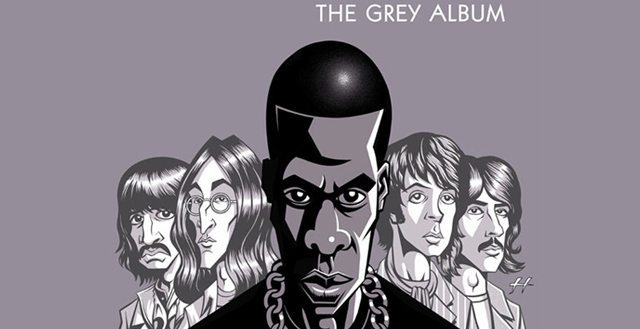
Many of you will remember Danger Mouse’s 2004 mash-up album of Jay-Z and The Beatles, The Grey Album. It was a massive internet sensation, critical success, and also was distributed for free.

However, Danger Mouse didn’t clear the samples. While Jay-Z and Paul McCartney both made public statements in approval of the Grey Album, EMI (owners of the Beatle’s White Album masters) raised a legal hell-storm and put the fear of god into anyone and everyone who had a hand in distributing MP3s from the Grey Album.

EMI eventually backed off, and Danger Mouse got away unscathed. Some say this was because the Grey Album constituted Fair Use; others say it was due to the horrifically bad publicity EMI would have received if they’d proceeded; still others believe EMI eventually crumbled under pressure from their stable of artists (wishful thinking, if you ask me).

Two important takeaways from this tale: first, always remember that an artist’s permission to remix or distribute a song may very well be meaningless. Many artists (even big ones) don’t own their own masters – at least not outright. Second, in the world of copyright infringement, being an artistic revolutionary is much safer than being a profiteer.

We’re excited to have brought you this article based on your feedback – do you have a legal-related issue that you want an article written about here on DJTT? Hit up our User Voice page

Want to read more about The Grey Album and download it if you were under a rock in 2004? Check out Illegal Art’s page devoted to exactly that. 

Finally, if you’re interested in additional writings on where entertainment, life, and laws intersect, check out Noah’s blog, LawCue.  
I Loved This Article >


  • http://spencerthayer.tumblr.com Spencer “Thunderball” Thayer

    This post should shut up all those DJTT haters who are moaning about the quality of content being put out. At least for a while. Assuming they even bother reading it. Seems like the most interesting articles get ignored. Either way informative article.

  • http://www.mojobojo.com/ Brian Jones

    This article couldn’t have come at a better time.  I was scouring the internet last night trying to understand exactly what the implications of using samples from other works were, it’s definitely a confusing issue.  Thanks for explaining things in such detail.

  • Misterfaust

    EMI backed off because there was no money made. The amount of legal options you have off of a zero profit remix are pretty low lol.

  • His_mouth_is_open_4_a_reason

    Yes, you and the balls you coddle are right bro!!! the other 12+ people  who commented negatively have no idea what they were talking about in the BT article everyone else on the planet but you and the djtt staff are complete uneducated losers!! I know right!!

    thank god you finally set everyone straight!!!

  • Donmecz

     100% agreed!

  • http://www.facebook.com/lewislace LewisLace

    I’m glad this was written. I’ve gone research on this a number of times and have been confused by the differences in UK law and American law dealing with the process of paying royalties. This is very treacherous ground for the thousands of upstart producers doing bedroom remixing. Learning a lot from this articles and very full of valuable information. 

  • lexor

    A few years ago I tried to research this myself and it amounted to an incredibly difficult search that wasn’t very fruitful and me still being completely clueless as to how much I could sample a work or what constituted Fair Use. While Fair Use is ambiguous, this clears up a bunch. What it doesn’t clear up is due to the ambiguity of copyright law rather than the article. Thank you very much!

  • TwoColorShoe

     It doesn’t matter if the person isn’t making money off of the derivative work. It is still copyright infringement. The bad publicity, coupled with the fact that at the time Danger Mouse was (and I think, still is) fairly poor, meant that even if EMI did sue (and they would have won), it would have only cost EMI tons in legal fees.

  • http://www.facebook.com/people/Alex-Catalán-Flores/522849442 Alex Catalán Flores

    For more on intellectual property, watch this: http://en.wikipedia.org/wiki/RiP!:_A_Remix_Manifesto

    A documentary based around Girl Talk. 

  • Peterdjs

    Spencer for hired, can you be anymore obvious. Again, you’re running out of content bro. You published this article around 7pm pst, on a Sunday, really. DJTT, stick to selling gear.

  • http://www.facebook.com/VicioussHoff Viciouss Hoffmann

    I always quote this documentary to my friends

  • Dj Just Greg

    Where does putting up a bootleg remix for download on Soundcloud fall in? We’ve all seen remixes to take from there and surely at least one of us has nabbed the thing. Clearly there must be infringement here. Can one try the “Fair Use” defense? Or is the “uploader” lucky due to the sheer volume of others doing the same thing? 

    Thank you so much for this article!

  • http://twitter.com/DJMISTAREDD DJ MI$TA REDD

    Very good article..Ive been uploading remixes to soundcloud and they kept taking them down due to infringement.  I ask them to explain the situation to me they told me i could file a complaint against the record company. It got me upset because there were tons of people doing remixes w/o permission “im sure” and their work was still up. Anyway this gave me the full 100 explanation that i was looking for. Great Job again DJTT.  

  • http://www.mo-beats.com/?p=1633 DJ MO-B » Mo’s Woche 12

    [...] Beitrag von DJ TechTools belichtet das Thema v.a. aus der Sicht der [...]

  • RoyalJelly

    Great article. I’m still confused about uploaded mixes/remixes to soundcloud/youtube. How is it that some mixes get free and clear without any censorship and others are muted/taken down? I know not everyone is writing the record companies asking for permission -_-

    For some youtube DJ’s they are making serious ad revenue off their respective channels. How much of that would a record company be entiltled to? I understand some of it would be under the Fair Use, but who determines that? The record company? I’m pretty sure they would be fairly biased if that were the case.

  • thisisrios

    Very informative, thanks dudes.

  • Lolavatar

     to be fair – lol its pretty funny when you brown nose while making your d!ck sucking face spencer.. maybe you just need to swallow maybe Ean will wink at you more often! exciting!

  • gary

     It also should be noted that the Gray Album controversy caused a major boost in Danger Mouse’s profile and put him in the mainstream, which led to the career he’s had since. No Grey Album. No Gnarles Barkley.  

  • http://twitter.com/cromabeats Marco Flores

    Wow this was an outstanding article! I found it very useful! Just curious though, is it true that if you release a bootleg remix of a song for free you don’t have to worry since you’re not making a profit? Or is that another myth?

  • Aliã Bianco

    Guys! Came to Brazil and be happy!!!

  • http://spencerthayer.tumblr.com Spencer “Thunderball” Thayer

    For the sake of argument let’s say I am a homosexual. Are y’all implying there is something wrong with that? Seems like there is a thick layer of ignorance and homophobia motivating your posts. It would be novel if, instead of falling back on played-out frat boy ad hominem “attacks,” someone would addressed the original point.

  • http://www.facebook.com/fundando Fernando Romero

    This is a great article. Thanks. Lots of useful stuff

  • http://lawcue.com/2012/03/26/copyright-considerations-for-djs/ Copyright Considerations for DJs « Lawcue

    [...] another article I did for DJ Tech Tools on Copyright Considerations for DJs. Share this:TwitterFacebookLike this:LikeBe the first to like this post. This entry was posted in [...]

  • the beijer

    great article. I say no more. 

  • superfly

    Myth. Without permission, or a viable Fair Use defense, it is infringement.

    The question the owner of the recording and/or the composition will have is whether they can show damages, and whether it’s worth the time and the money to sue.

    Just because you didn’t make any money doesn’t mean there weren’t damages, your remix, distributed for free via the internet, could effect the market for, and sales of, the original, if an owner can convince a jury of this, you could be liable for those losses.

  • Upbeatentertainmentny

    good read , thanks!

  • Lolavatar

    Is that why they call you thunderball?

  • http://www.facebook.com/people/Andrew-Dorsey/572954231 Andrew Dorsey

    Great article. have been wondering about this topic for a long time.

  • http://vektorbpm.net/news/copyright-concerns-for-digital-djs/ Copyright Concerns For Digital DJs | VEKTOR

    [...] We’re excited to have brought you this article based on your feedback – do you have a legal-related issue that you want an article written about here on DJTT? Hit up our User Voice page!  [...]

  • Anonymous

    Great write up! A really good look at the basics of Copyright Laws. 

  • AkaTheAGB

    Great post! Thanks a lot for responding to my e-mail regarding this issue. It was very informative!

  • http://twitter.com/Lylax_Dubs Lylax

    cleared up some digital Acme I had.
    thank you

  • rythmc

    Great article, the legal ramifications of what I’m doing musically has been on my mind lately :P. My roommate whos in law school turned me on to creative commons as well… a good option to look into if you’re producing music. 

  • http://profiles.google.com/gowers alex gowers

    At the end of the day you cannot get sued unless you are making money. If you are making money big or small from records you would be wise to clear them samples or not use them, not even replaying them if you have been refused clearance. Best to play/replay everything and keep the sources secret.

    As far as copyright in live or dj sets, no one cares. Play what you want. DJs have no limits.

    As far as live performance is concerned, unless you are doing a total cover band thing don’t worry, no one is gonna chase you for money if you slip in some samples and replay stuff.

    Girl Talk is testament to being able to be huge, play nothing but other peoples records in snippet form and never get rich.

    The article kind of got there but really went a little far on scaring off creativity.

  • http://www.brimdog.com/djtechtools-copyright-concerns-for-digital-djs/ DJTechTools – Copyright Concerns for Digital DJs | BDRaudio

    [...] DJ Tech Tools – Copyright Concerns for Digital DJs [...]

  • Morten

    Great article, in reality nobody cares if you make your own edits, remixes or mashups as long as a) your name i david guetta and you make a shitload of money, og b) you start selling them commercially. :)

  • http://www.magneticmag.com/2012/03/how-serious-do-you-take-copyright-law/ How Serious Do You Take Copyright Law? | Magnetic Magazine

    [...] Then continue reading for tips to help you navigate and take advantage of copyright law! [...]

  • TSt3f

    Great  article! So where would mashups fit in since they don’t usually contain original material composed by the mashup-er?

  • damagedgoods

    Right so yeah. What was this about again? Sorry its just I can’t hear anything over the sound of twats trying to give it large with their macho bullshit posturing…. Fuck sake anyone can be tough from a 1000 miles away behind a keyboard.

    Make music or fuck off.

    Now, in regards to copyright infringement the question is this….do you care? Do you care if someone gets sand in their vagina and sues you? Do you care if you make money for the music? Do you care if you have to bang it out on a cheeky white label? Would you care if I did it to your tune? Do you care enough to not make that bootleg that just won’t stop going round and round in your head?

    Do you care?

    If the answer is yes you should become a lawyer for a record company.

    If not, then game on gentlemen ;)

  • TCMuc

    +1

    Even though it’s a great article I feel like you left out an aspect of copyright that seems to be most important to many DJTechTools readers: the implications of copyright on DJs, especially regarding uploading mixes or the distribution of mixtapes for promotional reasons…

    Soundcloud explicitly forbids to upload mixtapes, even though they seem to generally accept it unless record companies want certain songs to be blocked from uploading. Still, if they decided to enforce their own terms & conditions there would be no more mixtapes on soundcloud. Even worse: anybody could be sued for uploading a mix containing copyrighted material…

    The situation regarding Youtube is identical to that regarding soundcloud,afaik.

    Diffent story for mixcloud, as they have contracts with performance rights organisations so people are legally allowed to upload their mixtapes to mixcloud.

    Would be great if you could make another article concerning “copyright for DJs”, as more people on here should be DJs, not producers…

  • Drdarce

    Very helpful. Thank you!!

  • http://www.facebook.com/DJTEEOH Shuriken Tenshii

    Wow, alot of info i didnt know and gratefully accept. Great article DJTT.

  • http://twitter.com/jasontll Jason Lee

    What about the remake/remix of a track? which no sample were used and the main melody were recreated using other instruments and everything else were original?

  • djsharkie

    good thankz for da heads up i was wondering what about making a mix cd what are the rights for tahat

  • http://twitter.com/thaswiz swiz

    another quality article. today I learned 2 new things. how to paint my apartment and how to not get in trouble when dj’in or mixxing. thanks!

  • http://www.facebook.com/profile.php?id=565885017 Nilesh Parmar

    top notes -great read and thanks for writing this…

  • http://www.facebook.com/profile.php?id=1063140313 Kyle Mogilev

    Great post! Cleared up a lot of questions for me.

  • http://lawcue.com/2012/04/06/fair-use-faq/ Fair Use FAQ « Lawcue

    [...] money it might be easier to use the Fair Use defense to infringement (described in more detail here).  Money could also a factor in determining the amount of damages at stake.  Be aware, though, [...]

  • Dj Elementz

    They made their money when it was released, that’s good enough. Move on and make more material. Don’t make music if u are just going to be living in the past worried about what u did and the money. Artists should feel lucky that there are people who like their material and want to use it in a way that inspires others. Don’t do music to make money, do it cause u got passion for it and keep focused, because how u gonna complain when u get a creative block cause u are tied up and worried about some legal battle for something already done and completed. Your going to look stupid and greedy. You should have gotten paid by the record company for your release and tha’s it-1 time if it continues to sell then it will for years. The only residual u should get is that feeling of self accomplishment knowing that u made something good and their are people who admire it and are inspired. U cant buy the feeling u get from a song or movie u create it, then sell it. And if u plan to make a living from 1 hit record or movie make it a good one because most people would rather have the original. I’m not sure but how long was / is Dark side of the Moon been on the charts. And nobody should, could, would really dare to try and put their own fingerprint on it cause it was just done to good. I dont see them crying about money, no pun intended. But i think it’s best to just keep creating and forge ahead. Mozart, is the prime example. He created masterpieces and nobody pays or paid residuals to him. And their are companies out there and composers who sell and perform his works. I will speak for him and say… that’s not why the music was created for economic gain. And u will receive your judgement in the same way if not more severe for the way u have exploited, cheated and profited from works u had nothing to do with or consent from me.

  • Dj Elementz

    Now I’m just a dj, but If i were a producer i would retain all rights to my music and use the labels as nothing more then street soldiers for distribution only. If someone were to approach me for my permission to use my material…then that’s my decision. If i respect a certain piece of work to a certain degree, then i might ask ”what direction do u plan on taking to redo my work, if it’s a sentimental piece then maybe i’ll want to play the riff physically myself  because i have respect for how my creativity is portrayed or maybe i can just say yes or no OR…maybe i’ll ask you to make me a comepletly original made from scratch vocal appearace, do a beat or be a session musican in a track to put on my next album.Then i would say …imitation is the most sincere form of flattery. Then i would pat myself on the back.Good job! I made music to be heard and i guess someone heard it. But if it’s the group’s or mine solo it is the decision of the creator. Ask though…if u just rip shit off then that says alot about who u are and where your comin from in reguards of your intentions to making music or movies. Then word will get out u got no real respect for the material…so then why do it anyway. But it’s the best way i can think of that’s reasonable. But as for the big companies or government they have no say in who or what is being done with my creative property. And as for the music in the public domain they rip off and distribute Beethoven, Chopin, & yes Mozart. They should charge the cost of the format they are using. If it’s a cd u pay the cost of the disc and that’s it, because there are companies that have been ripping off those compsers since the beginning of media. They probably dont even have the good sense to send flowers to the grave of Wolfgang, Ludwig and Frederick after the millions no probably billions + that they have stolen. They Got sum mutha@*$% nerve and why is the govenment involved, that’s shady.The fact is creative people or  ’artists’ are more popular and loved by peoples of any culture, and basically influence one’s or even a whole societys way of being…living. And are more popular than politicians. Because creative people are genuine, they work from the soul,and give people hope and inspiration u can draw from within with their work…not by dressing in suits reading cue cards and misleading the whole damn country with false hopes and dreams constant argueing between parties, which divides people more than unite. U dont see protests at concerts, artshows, book signings, cook-outs…people come together. The people always have the power, and me being one No Government will live my life for me, it’s mine. So i say more artists creative people need to shape societys not like the conman laywers in power right now who wouldn’t even loan me a single dollar from their pocket or give me a ride home in their tax payer issued limos.We the people are in charge here and i for 1 have had enough and want to see genuine people creative people who think in terms i relate to not the prick who went to some ivy leauge college that have been shaped by the same system and therefore are not creative at all cause they’re all bred from the same system. And are so arrogant they think they deserve to represent ME! They are so far out of touch. Unlike a struggling dj who has seen some shit been through some shit still have passion for my creativity as well as having a real idea of being self made .i was  not shaped,scholarshiped, and privlaged. Vote every single one of them out i say and get creative people who have and can display their talents truly want to help, not just have another term in office. that’s all it is for them.They make more laws these day telling u what u cannot do as opposed to what u can. And they are just as guilty as those big media companies whom they protect that steal from the Deceased. So screw their copyright and just originate or have the decency to ask the creator.And besides why make music food art and literature if u have a problem sharing it anyway.But as usual who knows if anybody will see this anyway. Just like the way they dont see me spinning in the clubs, I play for my own enjoyment and to stimulate a mental challenge, not to be seen or for anyone in particular, well maybe GOD…!  It makes me happy and has probably kept me alive and out of jail too so that’s why i have done it 17 years. It’s really that simple for me. Dead or in Jail or DJing? Same thing almost huh.Except creative people like to stay busy not get an indictment like the crooked thugs who think they can determine my American Dream. I just might leave and get my own island if it keeps up cause no punk in a suit with a degree in bullshit, represents me and my best interests, and how to live the life god gave me…ok…! the government has nothing to do with me being on this planet. I’m a dj…I turn tables

  • http://sandiegoturntableinstitution.wordpress.com/2012/04/30/copyright-concerns-for-digital-djs/ Copyright Concerns For Digital DJs « sandiegoturntableinstitution

    [...] Copyright Concerns For Digital DJs [...]

  • http://www.djtechtools.com/2012/05/08/got-hot-loops-filling-out-your-softwares-sample-slots/ DJ TechTools  |  Got Hot Loops? Filling Out Your Software’s Sample Slots

    [...] [...]

  • http://sellstructuredinsurancesettlement.biz/your-questions-about-the-implications-of-copyright/ Your Questions About The Implications Of Copyright | Sell Structured Insurance Settlement

    [...] [...]

  • TheBigBlaa

    Copyright licences for digital djs:

    http://en.wikipedia.org/wiki/Digital_DJ_licensing

  • Alaa Bahour

    some one please help i feel liek this didnt really cover what i wanted…
    we are working on a track that uses the theme song to a movie in it…..
    tried to make it legit made an account with universal pics but they wanted over 2000 dollars which just seems unreal especailly to underground people like us. what do we have to do? would it be legit if we recreated the theme song?or just disclosed it ?…i really dont know what to do it sucks we have such a bad ass song and are scared to try and get it on beatport please help!!

  • http://www.djtechtools.com/2012/08/26/how-to-sample-any-sound-from-the-internet-and-create-a-unique-drum-rack/ DJ TechTools  |  How To: Sample Any Sound From The Internet and Create a Unique Drum Rack

    [...] and your voice. It also is not a surefire way to get super high quality sounds. Finally, there are a lot of rules and laws about sampling_kmq.push(["trackClickOnOutboundLink","link_503bb08ecc6ff","Article link clicked",{"Title":"there [...]

  • shootdaj

    Well, I don’t “care” in the way you’re suggesting, but I do want to make sure that I don’t get sued by labels for using a track that technically belongs to them. So in a way, you have to care even if you don’t have much of an opinion on the labels to protect yourself.

  • http://www.thecurrentvibe.com/copyright-basics-protecting-a-musicians-work/ Copyright Basics: Protecting a Musicians Work | The Current Vibe

    [...] TechTools pointed out in Copyright Concerns for Digital DJs that a copyright for a musical composition includes every single “original stem” in the [...]

  • Cam

    Question. If i were to make a mix and put it on youtube but no download links or anything and put the names and titles of the songs in the descritions with the record companies and stated that they owned all of the music and that this was in no way to make a profit of any kind, would that be o.k.? In hind sight am I not still gaininig plublicity from using their music and thus could it still be infringment and if it is is there a license you can buy and where would I find it?

  • http://ma5wright.wordpress.com/2013/03/29/hyperlink/ HYPERlink | ma5wright

    [...] and artists’ and therefore entitled to create. Enter copyright – the bad guy. According to the letter of the law, you need permission from the copyright holder of the original wo… Home producers, including a majority of videos posted on YouTube violate copyright laws, this is [...]

First Time?

This site is dedicated to digital DJs. We develop performance tools and teach cutting edge techniques that enable creative expression. Visit tutorial videos on youtube, equipment reviews in the blog and a very helpful community in the forum. New articles every Mon, Wed, Fri.

RSS DJ TechTools Forums

  • [Trance] I need your thoughts!
    Track I am working on, what do you think? All thoughts are appreciated! https://soundcloud.com/c_samuelsson/preview-no-title […]
  • Traktor BPM Problem!
    Along with DJing , I spend the majority of my time producing music! I made a track that begins at 128bpm , and is 128bpm for approximately half... […]
  • iTunes Library and Traktor Collection
    I'm really struggling to understand the relationship between Traktor's Collection, and an iTunes Library. I understand that Traktor will read the... […]
  • Question about a mixer
    Hi there! Well, I've been looking to buy a 4-Channel Mixer lately and the one that surprised me was the Behringer NOX606 (I know, I know, Behringer... […]
  • [Progressive House] EDM Mix Youtube Video (Chris Astro)
    Please check it out and share with friends! First video mix I have made. I did NOT SYNC most songs were already at the same bpm or I jumped bpms. I... […]

DJ History: Spring 1979′s Issue of D.J. International

Read More...