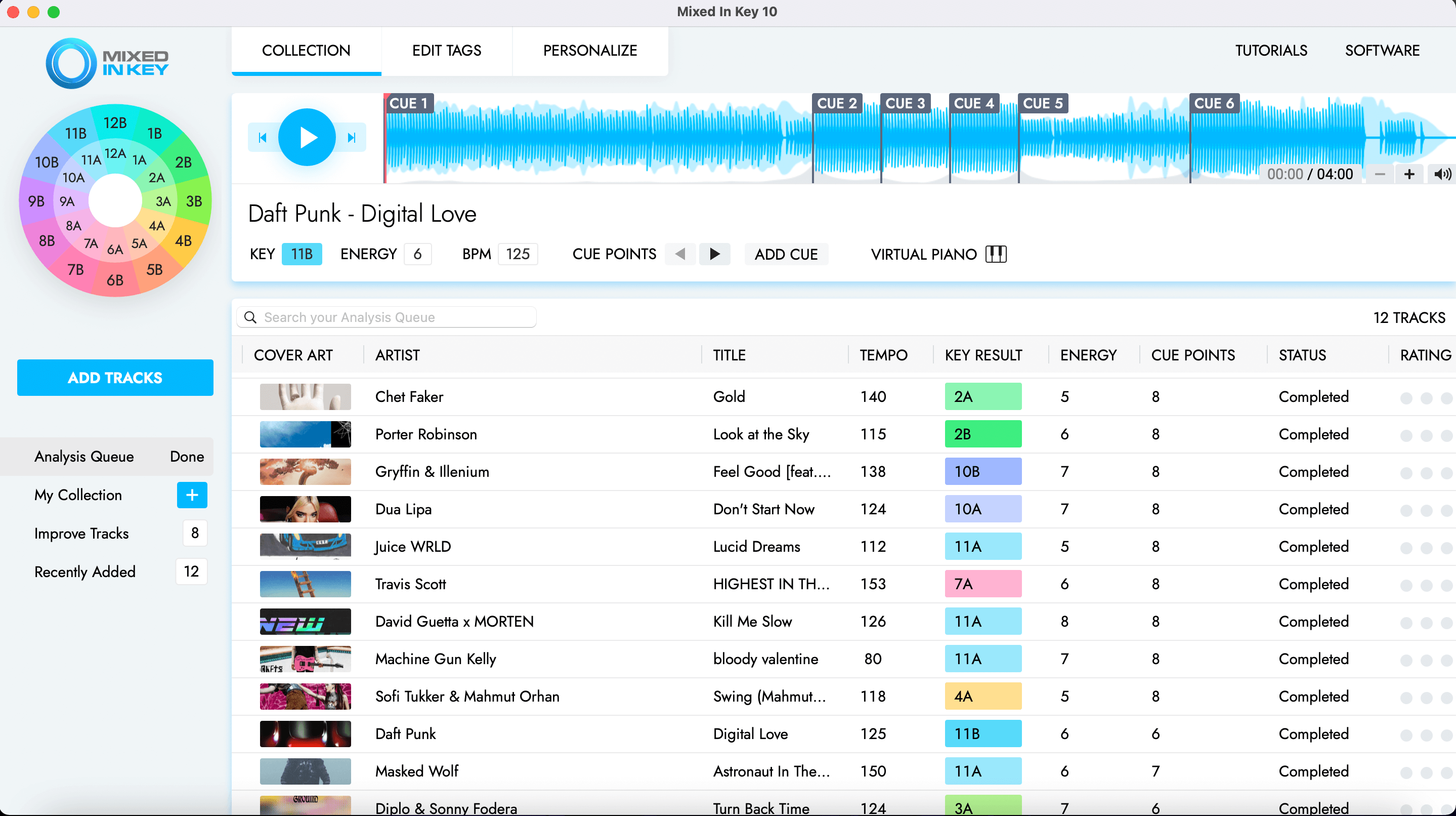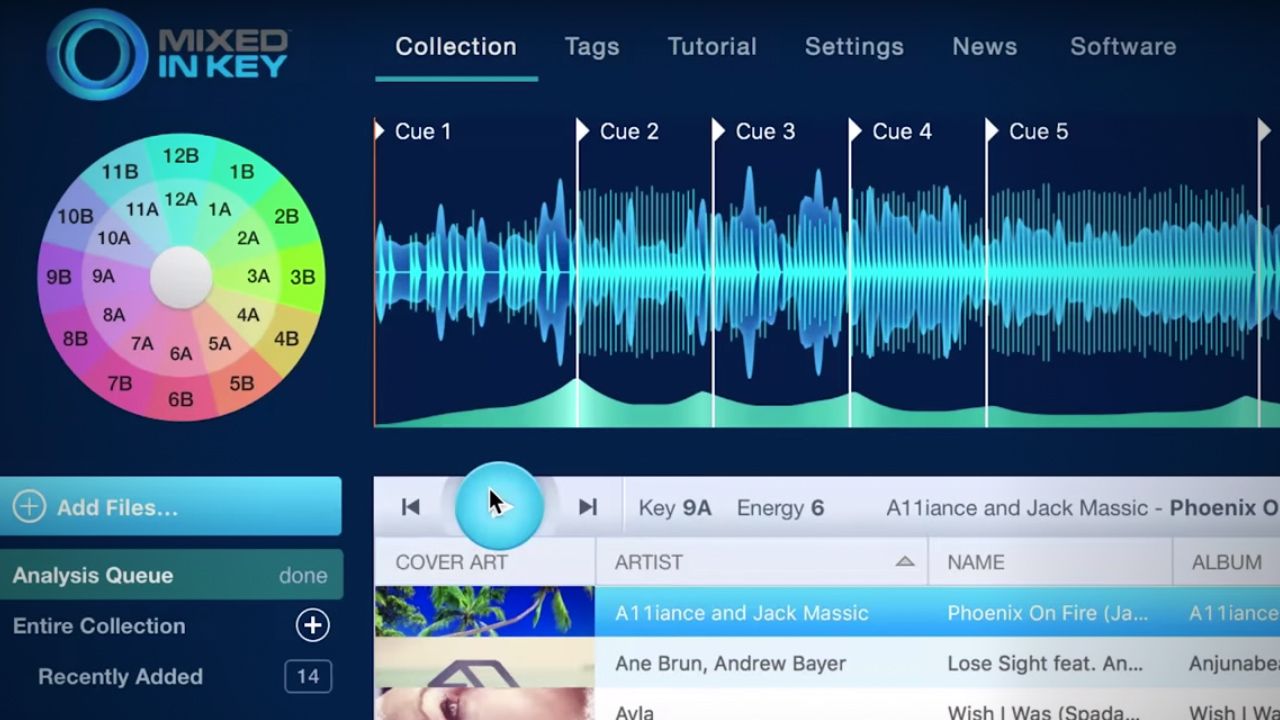
It’s been almost two and a half years since the last DJ TechTools key detection software comparison. Times have changed and the software has moved on, so we took a fresh look at the capabilities of Mixed in Key, Rapid Evolution, and Beatunes-  and we also discuss whys and wherefores of musical key, too. Ready to see which software won this time?

THEORY FOR DUMMIES (BY A DUMMY)

First, a crash course in music theory for DJs without any extraneous tangents. This might be tough!

A musical key is a group of notes that play well together, and in western major and minor scales there are seven notes out of a total twelve per scale. Major scales work by starting with a note  – this note is called the tonic, and becomes the name of the key – and moving up the semitones in the following steps: 2, 2, 1, 2, 2, 2, 1.  Minor scales start with the tonic and move up the semitones in this manner: 2, 1, 2, 2, 1, 2, 2 (there are a few special rules for different types of minor scale that involve differences when moving back down the notes, but for now this will suffice).

The scale pattern is always the same, so some keys play almost the same notes even though they focus on a different tonic (move up seven semitones to see this; only one note will be different between the two keys and it will be due to where available sharp/flat semitones throw the pattern). Because of the cyclical nature of moving through tonics – eventually you will come full circle – keys can be placed on a circle which indicates which keys are most similar, and this circle is called the circle of fifths. This is true not only for the major and minor scales independently, but there is also a relationship between a major and minor scale which share most notes.
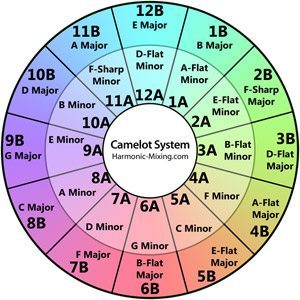
The Camelot wheel gives the twelve tonic scales a number, so that rather than having to remember the relationship between scales one can simply look for numbers – in the heat of the moment this is a simpler way to think about key relationships than memorising the circle of fifths.

FINDING KEY

The only way to find a key is to dissect a song and distinguish the notes that are playing. A good musician can do this by ear; in much the same way that learning to beatmatch tunes your brain to be able to distinguish different rhythm metres in isolation, training can enable you to separate pitches (if you have true biological perfect pitch and train yourself to recognise pitches as note values you can know a key almost instantly, whereas most of us aspire to a well honed sense of memory based relative pitch). You can also always play along with a song on a keyboard until you find the selection of notes that don’t clash and derive the key that way.

Computers can analyse audio files and pull apart the notes too. The reason for all this theory is to help you understand how to interpret the results that computer software comes up with and understand how relevant they are. Considering the above, you should be able to understand how the following can throw a computer (or indeed a human) key detector off the scent:

  • If a song does not use all the notes in any key, then its key might be ambiguous. Whilst a huge amount of songs are chord based and thus use all notes in a key, a lot of electronic music uses very little melodic content. A song that only has three notes could (depending on the three notes used) be any number of keys, and the only real way to secure which is correct is to identify the tonic.
  • It is possible for a song to be composed – entirely unintentionally – in more than one key by a producer who noodles without any attention to music theory. It’s not uncommon for a song to drift around a section of the circle of fifths throughout the course of a song, because it’s not particularly jarring to do so in many cases it often goes unnoticed.
  • It is possible for a song to be intentionally composed to change keys conspicuously. Key changes are a way of changing the mood of music, and many artists use this as a tool in their songs.

If a track has a key change in it, it will be impossible for a key detection programme to tell you what key the track is in for what should be obvious reasons. However if there is a little key drift or perhaps a small section of atonal (not in key) audio, we might hope that the software would have a punt at the most likely to be compatible. Similarly whilst we could forgive a key detection programme for not being able to conclusively tell us a key where one isn’t clearly defined, we’d hope it could be somewhat accurate in its guess of the tonic.

THE TEST

Let’s take a look at the three DJ key detection software options we’re comparing today:

  • Mixed in Key is the most well known of all the key detection software. It runs on Zplane’s Tonart key detection algorithm (Zplane make the Elastique realtime timestretching/pitching algorithms used by many major software, from Ableton to Native Instruments; although not Serato, who use their own). Tonart’s also used in Djay and a few lesser known alternatives for native key detection. We’re testing version 5.
  • Rapid Evolution is the only free offering of the three here, and whilst the stable version is still at v2, today we’re going to test the public beta (58) of version 3.
  • Beatunes is another commercial alternative that not only finds key but is capable of a bunch of other housekeeping. We’re testing version 3.

Why haven’t we included Mixmeister, as we did in 2009? Put simply, I don’t feel it’s particularly relevant at this point in time. It’s been more or less blown out of the water by Ableton Live, Traktor, et al, and buying a fully fledged, $200 piece of software simply to extract key information from it seems ridiculous.

Okay, so the test. From a broad but realistic pool of genres and styles I selected 50 tracks, cranked the accuracy sliders on the software up, and let them get to work. To ensure that the results of the software are being compared to accurate real world results I brought Mark Davis, creator of the Camelot Wheel and one of the major proponents of harmonic mixing, on board. Mark determines the keys of songs manually, and guarantees his results are 95% accurate; he has amassed a jaw dropping database of over 55,000 key matched tracks over 20 years of research and sells the database in book form (with regular electronic updates and an electronic search) from harmonic-mixing.com.

RESULTS
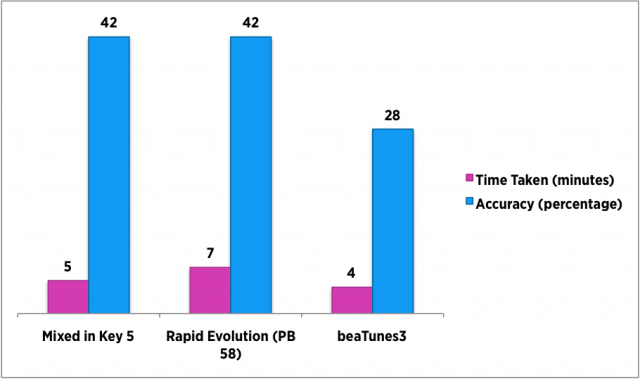

Key Showdown Results (click the link for the full test as a PDF)

Mixed in Key 5: 42%

Time taken: 5 minutes
Good at: Looking good, detecting key and giving camelot values
Not so good at: Being affordable – it’s the most expensive option on test.

beaTunes: 28%

Time taken: 4 minutes
Good at: Integrating with iTunes and doing a load of housekeeping above and beyond key detection
Not so good at: Camelot mode – it doesn’t exist. It’s also the least accurate at our test tracks.

Rapid Evolution: 42%

Time taken: 7 minutes
Good at: Detecting key for free!
Not so good at: Having a good interface. 

CONCLUSION

If you have a massive library, key detection software can be a huge timesaver. The 2008 MacBook used is starting to show its age, but as you can see it handled the task with ease and time taken was simply not an issue for any of the software on test. As long as the software gets most right, you’ll be able to weed out the ones it messed up on or couldn’t detect and do those manually, or pay someone like Mark Davis to tell you. At $20 for 100 tracks from Mark – that’s 20 cents per track – you’re getting decent value for money if you’re not confident finding the keys yourself. If what you want isn’t in the database, though, you’ll have to wait until a listening session to get your custom choices recorded.

As for which key detector is the best, the numbers don’t lie. Beatunes was the quickest (although as mentioned there’s barely anything in it), Rapid Evolution and Mixed in Key were jointly the most accurate, and while Rapid Evolution’s free – MiK has a much nicer user interface. Those are probably the three selling points vying for your attention (excepting Beatunes’s inability to detect Camelot key), so if you’re determined not to pay then it’s worth giving Rapid Evolution a run through because it gets the job done. When all’s said and done though, for the one off payment versus the lifetime of easier use, Mixed in Key gets our vote. Just remember that nothing beats a well trained human.

More info on each software: 

Mixed in Key 5

Rapid Evolution 3

BeaTunes 3 

See the results of our 2009 Key Detection Software Smackdown!


I Loved This Article >


  • Matt Hite

    Can you please publish the reference set of songs and their key value? Thanks.

  • http://www.djayggregator.com/2012/01/27/key-detection-software-showdown-2012-edition/ Key Detection Software Showdown: 2012 Edition | Djayggregator

    [...] so we took a fresh look at the capabilities of Mixed in Key, Rapid Evolution, and Beatunes-… Read more Go to Source Share this on: Mixx Delicious Digg Facebook [...]

  • frank bash

    i use mixed in key over 2 years now, perfect tool
    http://www.frankbash.com

  • Firebird079

    Could you guys please compare Trainspotter’s(
    http://www.tspotter.net/ ) key detection? I’ve been using it because it only cost $10 and makes organizing my collection a bit easier with the beatport tagging. 

  • Anonymous

    regarding camelot mode for beatunes 3… it sorta exists with the plugin i made: http://yeahdef.com/?p=6255

  • Dusty Bacon

    Like 
    Firebird079 I also 

  • Dusty Bacon

    Like 
    Firebird079 I also use Trainspotter (and support indie music software developers with donation$) I have used trainspotter key detection for every track in my library and would love to know how it compares

  • DJ Segatto

    Yeah, I like Trainsotter’s Beatport tagging as well, even if the interface is a bit complicated to learn

  • Bit

    There’s also KeyFinder http://www.ibrahimshaath.co.uk/keyfinder/ It’s free and I found it in the forums here

  • http://pulse.yahoo.com/_5LUAAXNGXJBO4VIRJZN5VASO7M Todd Hardy

    +1 And it’s opensource!

  • dafe

    a comparison to the keys beatport uses (and trainspotter by association) would be a nice addition to this list :)

  • Yakov @ Mixed In Key

    Hey guys,

    Yakov from Mixed In Key here.  Before we released Version 5, we wanted to understand music inside out, with nothing left to chance.  We hired 12 absolute pitch musicians and had them analyze 12,000 audio samples with a piano.  The musicians didn’t know what the others said, and we randomized everything to eliminate bias.  They had no benefit from lying to us — their work was scientifically valid.

    Here’s the interesting thing:  They couldn’t agree with each other.  We gave the same track to 3 perfect pitch musicians, and there was less than a 50% chance for them to agree on a result.

    Music is subjective.  I’ve talked with Mark about this before.  I love him as a person and a great DJ inventor of our generation, but I want to be clear on this:  comparing *any result* to a single person is a mistake.  It doesn’t matter if we compare Mark Davis to Louis Ng (one of our 12 perfect pitch musicians), or Mark Davis to Rapid Evolution, or Louis to Mixed In Key  5.  

    I suggest:  Pick a person you love working with (and have them key your music), or pick a software that you enjoy using, and stick to that ONE source of your results.  Mixing results from Rapid Evolution into Rapid Evolution sounds great.  Mixing results from “Mixed In Key 5″ > Mixed In Key 5 will be excellent.  

    I use results from MIK 5 and I get exactly what I need.

    -Yakov

  • Wes

    seems this review was pre-mature. kudos to Yakov

  • Mynak

    You guys messed up the results. Your PDF shows that Rapid Evolution missed 3 songs when it got them correct, it just showed the format as sharps instead of flats

    Deee-Lite – Grove Is In the Heart
    Key: Ab mRapid Evolution: G# m

    Happy Mondays – Wrote For Luck
    Key: Bb m
    Rapid Evolution: A# m

    Michael Jackson – Off The Wall (LP)
    Key: Eb m
    Rapid Evolution: D# m

    These are all the same results, just delivered in a different format. Rapid Evolution can also deliver Camelot keys.

    http://en.wikipedia.org/wiki/Enharmonic 

  • PY

    I’m sorry but I have to disagree. When it comes to finding the key of a track, it is definitely not subjective. I have perfect pitch, and am right 99% of the time. If your perfect pitched musicians couldn’t agree, it’s just because some of them weren’t trained well enough. Every single piece of music have a specific key. I can modulate, or be a certain mode, like Locrian, on Lydian, etc. But still, there is a key.

  • Djsatirocreativo

    NADA SE COMPARA AL OIDO Y AL INSTINTO DEL DJ

  • Mynak

    Also, if you want to add in the compatible results

    Rapid Evolution:Correct – 24
    Compatible – 10
    Wrong – 16

    Mixed In Key:
    Correct – 21
    Compatible – 12
    Wrong – 17

    Beatunes:
    Correct – 14
    Compatible – 11
    Wrong – 25

    Overall, the difference between Mixed In Key 5 and Rapid Evolution is statistically insignificant, especially in such a small sample size. Mixed in Key may have better results when you compare thousands of songs or Rapid Evolution might.

    Like the author stated, if you need free, then go for Rapid Evolution. It’s buggy and very resource intensive, something you do not want to run simultaneous to a DVS or MIDI controller program during a gig. Rapid Evolution’s interface is very basic, you can only store 1000 results default, and the options menu isn’t easily navigable. However, if you put in the time and you need something free, it will get the job done and can export the tags.

    Mixed In Key is absolutely worth the price. Easy user interface, does what it needs to do. If you have any problems, you have dedicated people there to offer support (hard to complain about free software like RE3). One time payment and you’re taken care of.

  • http://twitter.com/speshuled Ed Buckel

    It seems like there should be a website out there with key information.  I remember back in the day I used to use Tag&Rename to tag all my mp3s, it would grab the information from Amazon.

    It’d be awesome to have something similar for keys, bpm, etc – people could vote on which key if there were discrepancies, the highest vote goes to the top and is used to tag the tracks.

    Keep it open source and social and everyone wins.

  • DonmecZ

    Muy Cierto, No nadamas porque 2 canciones tengan la misma nota se escucharan bien mezcladas o garantizen que las mujeres muevan mas la nalga… jeje :)

    Saludos!

  • DonmecZ

    That is a GREAT Idea!!! I am all for it!

    Cheers!

  • Yakov @ Mixed In Key

    PY, I am sure you’re right that your results sound 99% good together.  There is no doubt about it.  But if I mixed your results with someone else’s, you’d hear key clashes a lot more often.  
    The guys and girls who keyed our tracks for testing are classically-trained musicians who played Cello, Piano, Violin, etc.  Their pitch was perfect according to an audition (and some even had certificates from hearing institutes saying so).
    I’ve been dealing with this phenomenon since 2007, and I spent 200+ hours investigating it.  Music is subjective, and I cannot explain it better than that.  I know that if they heard the same songs as you did, they would give different (but often compatible results).

    You might say 5A, they might say 6A.

  • Djeffvegas

    I have to disagree with both of you. Perfect pitch doesn’t mean nothing if you don’t know music theory. It’s one thing to hear the notes and it’s a different thing to know the “key”, the “tonality” of the song. You need to know the scales, harmony, etc… 

    Once you know that, and you have analyze the chord structure of a given song, there’s only one tonality possible.

    And by the way, in pop music tonalities like A#, D#, G# for example are Bb, Eb and Ab 99% of the time.

    That being said I use Mixed in Key!

    Cheers

  • Anonymou5

    I had to assist a DJ friend of mine re-install his PC a few years back (hes not a geek and somehow manages to kill his PC with so much junk). Anyway MIK was 1 thing to be re-installed (version 2 or something iirc) and just wanted to make a comment on it (Windows version).

    I was shocked at how this software has been put together. It seems nothing more than a pile of free libraries cobbled together and a very basic GUI thrown over the top.. Anyone who knows what “GOTO” means could have created it.

    Anyways, i set the challenge and knocked out a MIK clone in just a fraction over 2 days including a few more features (oh! and it used RAM, not countless temp files and had multi-core support)

    About 1 year ago this friend called me over for a re-install again and by this stage he had upgraded to MIK v4. After the install i was curious and asked him why he upgraded? – “It’s just better and more accurate”, i just nodded and said “ok”

    I find it most interesting that newer MIK’s claim to have improved key detection etc! MIK uses the tonart library as many know and this hasnt been updated in several years. Most of the technology has been developed by others (key/bpm detection, audio decoders, tag handling etc)

    The only difference i noticed were tiny UI cosmetics and more importantly the inability to use the app without an internet connection under the pretense it needs to ‘check with the server for a for a better result’ (or something to that effect). “Bollocks!” i thought. it still uses tonart, accuracy has not improved at all. Usability had been reduced by the internet requirement and it was still flogging the HDD when processing.

    Quick thoughts:

    * MIK
    - Pretty UI
    - Good exercise in marketing
    - Accuracy wont improve until something compliments/replaces tonart
    - Lots of large temp files

    *Rapid Evolution
    - Average UI :/
    - The algorithms and tech is developed by RE and under complete control
    - Has media management too (arguable if this is relevant, good or not)
    - Java :/

    I just checked and noticed MIK 5 is the current version. multi-core supported ;) I hope for the users it’s a technical improvement over previous versions. The screenshot might suggest workflow has improved and some more (nice looking!) cosmetic makeup has been applied once again ;p

    This is not a stab at MIK. It works, it uses the respected tonart library. It looks nice. I was just shocked in the past at how much work actually went *into* the MIK application itself vs RE yet its the most expensive. The visible key segments in a track look nice too :)

    Either way.. however the core function (key detection) is achieved doesnt matter i guess. So long as they are accurate and continue to improve :)

    Kudos to MIK and RE!
    Peace out

  • Anonymous

    Hi all, 

    An interesting article. I was just
    wondering what audio format was used for this test. In my experience you may
    get different result if you analyze mp3 vs wav 
    of the same track.  My guess the
    result from wav would be more accurate. 

  • http://www.facebook.com/profile.php?id=100001945260195 Rg Tb

    great article!

    if you’re using RE3, i suggest you head over to the mixshare website and shout out a thanks to the developers for all their efforts. for the last few months, RE3 development has been sluggish. i bet the guys will appreciate hearing some kind words, though.

  • http://www.facebook.com/profile.php?id=100001945260195 Rg Tb

    “Mixing results from Rapid Evolution into Rapid Evolution sounds great.
     Mixing results from “Mixed In Key 5″ > Mixed In Key 5 will be
    excellent”

    if that is so, why would anybody in their right mind pay for MIK5?

  • Marco Minniti

    There’s a plugin for beatunes so that it can write OpenKey notation in the mp3′s tag

  • http://www.facebook.com/warpnote Audun Notevarp Sandvold

    Would be really nice

  • http://www.facebook.com/warpnote Audun Notevarp Sandvold

    + 1

  • http://ax11.myopenid.com/ Tom

    Key detection hardware is more reliable and a lot cheaper: that good, old Boss DM-30 (about 5$ at eBay) which has a reference tone feature as well as the classic metronome stuff.
    1. Push button, compare and write BPM into notebook  
    2. repeat, notice key, put notebook and DM-30 back into pocket
    3. Profit
    Well, it needs (some) exercising, but that’s basic skills, not rocket science. And compared to price and quality of key-finding software you can only win.

  • http://www.facebook.com/profile.php?id=100000531686375 Futureglue Musik

    +1 for trainspotter. I just luv that program. 

  • Kainos

    Does anyone here know what Beatport uses to detect keys?

  • Anonymous

    Fyi..

    Major (starting from tonic): 2 2 1 2 2 2 1 *
    Minor (starting from tonic): 2 1 2 2 1 2 2 *

    Representing all 12 semitones. (The article only accounts for 10).

  • Guest

    I’m sorry, but any piece of music is composed and created with specific tones and pitches.  These are NOT subjective.  A frequency range is going to remain that same range no matter who’s listening to it.

    Music is not subjective, there is only human error.

  • AZ

    I got MiK 5 and love it it works like a charm and no headaces

  • http://www.facebook.com/ben.cove Ben Cove ?

    ok so i went and got mixed in key

    Analyzed all 2000+ tracks and got it to put key at end of track name

    Open traktor…. 2000+ tracks missing :/ just because i renamed them

  • Yakov

    Hey,

    Mixed In Key hasn’t shown tonart results since 2007. It’s been 4.5 years!

    Mixed In Key uses its own algorithm which was in MIK 3, 4 and 5. It was granted a patent in the US. I’m not sure where you got this info, but it’s out of date. We love zplane and use their libraries for other things, but the key detection is our own.

    -Yakov

  • Anonymous

    You should also consider the file types that the software is able to key, because it matters.  I use trainspotter and RE3 because MIK only supports 2 file types (from the last time I tried it out), mp3 and wav.

  • Adam

    I also have to disagree. Key detection seems subjective when the notes that are used in a song fit between similar keys. Say we have “song x”. And say the notes in song x fit both the key of C Major and F Major because song x doesn’t  use the note B natural or B flat. But there is a right answer because there is only 1 tonal center and let’s say the tonal center in song x is C natural. Even though it uses the same notes as F Major (without playing B or B flat) the correct key for song x is C major. Tonality is the same reason why C Major is different from A minor even though they technically use the same notes. 

    It makes a lot of sense to me that even musicians with perfect pitch might come to different conclusions as to the exact key of a particular song. Perfect pitch is being able to perfectly identify individual notes; and if the notes don’t tell the full story then a musician would need to correctly identify the tonal center to know for sure. Depending on the complexity of the music tonal centers can shift even if the key doesn’t. 

    Even though classically trained, perfect pitch musicians disagree on the key, there is only 1 correct answer. Even it’s as silly as E Major during the chorus, A Major during the verse, and D flat minor during the breakdown.

  • Chris Cartledge

    Thanks anon, I always forget to make that last step!

  • Chris Cartledge

    Ugh, nightmare. Have you tried ‘refresh’ing your library? This is one reason I quite like iTunes integration in Traktor.

  • Chris Cartledge

    There’s a pdf link for download in the test results!

  • Chris Cartledge

    This looks good Bit, thanks for the heads up! (I think he needs some more Google rank in my neck of the woods, as I didn’t find this in time for the article!)

  • Chris Cartledge

    Fair point Mynak, I suppose if the scales contain the same notes then the software can’t reeeally be blamed for having to guess what was written on the sheet ;) 

  • Durp

    lesson here – use your ears.  42 percent? seriously why even bother with a program that isnt even right half the time

  • ivanzilch

    you must have chosen either the “rename files” option in mixed in key or itunes’ “keep itunes library organized” – these two options gave me a big headache when i first used mixed in key, the rename files basically adds key info in the file names and the “keep itunes library organized” renames the itunes library file path as you add tags etc, rendering traktor confused on whereabouts the files, i recommend turning off these features before proceeding with key detection, make sure the tags are non destructive and paths and names remain the same in itunes

    just my 2 cents

    from a dude who had to relocate thousands of mp3s manually in the past due to itunes and mixed in key preferences accident

  • http://twitter.com/rainyrhy rainyrhy

    +1 Trainspotter

  • http://twitter.com/tschundeee tschundeee

    KeyFinder kicks all other tools asses:
    http://ibrahimshaath.co.uk/keyfinder/comparison.pdf
    Download (open source) here:
    http://ibrahimshaath.co.uk/keyfinder/

    Donate to support Ibrahim for his wonderful work.

  • http://www.eangolden.com Ean Golden

    Hey – Great comment! Thanks for contributing so much. i cant speak to the facts you mentioned but I just appreciate the effort. 

  • Tim Tilberg

    I was actually surprised it took so long to come up. I’m a pretty huge fan of Trainspotter.

  • BentoSan

    I originally came up with this article idea back when the first one was done, its great to see an update. Good work !

  • Peter P

    Any chance article author would run the track collection through Ibrahim’s KeyFinder and fix the sharp/flat errors in the .PDF?
    And big thanks for returning to this topic! :)

  • http://twitter.com/WooDzMuzik Anthony Woodruffe

    I run all my itunes, aac and m4a tracks through MIK, which gives me a result at the end. Whether it’s the right key, that’s a different story. What I do find is that mixing using MIK analyzed tracks doesn’t cause any clashes. So although MIK may not detect the right key it is sufficient to work within the circle of fifths. 

  • http://twitter.com/WooDzMuzik Anthony Woodruffe

    just using your argument to highlight to point that really it doesn’t matter. Fundamentally you are absolutely correct a song has to have a root key. The problem comes from the fact that as so few notes are used in one particular  track, it become impossible to know the tonic. The positive is that because not all notes are present it means that a multiple keys will work.
    Adam’s example was a track written in C major could be detected as F Major because both B and B flat are missing. When looking at the Camelot Wheel it means that the C Major track (8b) can be mixed with either 8a,9b or 7b. However because the track could also possibly be F Major (7b) it will also work with 6b and 7a.

    For a DJ who wants to mix harmonically, it is totally irrelevant what the true key is, what is important is what keys work with the track being played. The question has to be asked, can software or a trained ear be so far out on detecting a track that the natural flow of using the Camelot wheel would become useless? My thoughts based on experience is the detection is good enough for mixing tracks and that it what counts at the end of the day.

  • Chad

    Mixed In Key Supports:

    Windows.m4a (AAC).mp3.mp4 (key field not supported by Serato).flac.wav.wmaMac.aiff (tagging not supported yet).m4a (AAC).m4a (ALAC).mp3.mp4 (key field not supported by Serato).wav (can be tagged for Serato software)

  • Chad

    Sorry about the formatting, that came out awful!  The list is posted here:  
    http://community.mixedinkey.com/Topic.aspx?ID=9150

  • http://knappy.com/ Knappy

    I’ve been using MIK for years.  I had the privledge of beta testing v5 and as a DJ & VJ I would say MIK all the way.  They added mp4 analysis in there which has helped me tremendously.  I no longer have to copy them myself.

    Yakov… Great job!

    facebook.com/DJKnappy

  • http://www.beatunes.com/ Hendrik Schreiber

    Hey,

    needless to say that, as the author of beaTunes, I’m disappointed to see these results. Especially, since beaTunes has done a lot better in other tests (e.g. http://blog.beatunes.com/2011/06/beatunes-3-key-detection-accuracy.html).

    That said, as Yakov correctly pointed out, obtaining accurate reference data is very hard. In fact, there is no 100% correct ground truth, even if people who sell that kind of data would like to convince you otherwise.

    The next problem is statistical significance. If my math isn’t too far off, if you want to be 95% sure that the measured values for a 50 songs test fall within a certain interval of the real values, that interval is roughly plus/minus 12 percentage points. In other words, based on the posted results, it’s entirely possible and not even unlikely that all three programs perform equally well. To get to plus/minus 5 percentage points, you’d have to test with roughly 300 songs.

    The reason that beaTunes does not show Camelot notation is very simple. Last time I checked, it was a proprietary notation, that required licensing. I have never seen the point of this. Just like MixMeister, beaTunes therefore uses an alternative scheme, the open key notation (http://www.beatunes.com/open-key-notation.html). It achieves the same thing, but is free to be used by anybody who is interested in it.

    Another aspect of notation is the fact, that software writing id3 tags should actually comply with the id3 spec. And the spec dictates a musical notation. However, any software that shows you the id3 TKEY tag is of course free to render the information contained in the tag any which way it/you like. I.e. either as musical key, Camelot number or in OK-Notation. One just has to tell the DJ software vendors to offer this option. Once that is achieved, it does not matter what a key detection software writes to the id3 tag.

    Anyhow. All this said, I’m really glad you guys did this test. This allows us all to talk about the state of the art and also the problems with testing.

    From what I’ve seen, RE and MIK are great programs, obviously I prefer beaTunes :-)

    Looking forward to the next showdown!

    -hendrik

    http://www.beatunes.com/

    PS: Is there a way to add album names to the results? That would make it much easier to reproduce the test. Thanks.

  • DJ Sushi Mango

    Hi Chris. It would really be awesome if you can update your article with additional comparison aginst the Keyfinder software from Ibrahim Shaath. I for one, am very intrigued about this software. We need some stats. Pleaaaaaaaaaaase!!!

  • http://www.facebook.com/people/Soni-Singh/100001685101746 Soni Singh

    Thank you,
    The given information is very effective.
    I’ll keep update with the same.

    indian trading agents

  • http://twitter.com/TheModernDJ DJ Hombre

    Well said Hendrik, having studied Maths with Statistics a long long time ago, a sample group of 50 tracks is risible to offer any conclusive results.  Had it been 1000 across different genres then I’d be more inclined to have faith in the figures.

    Interesting article though and any education around considering key data during a mix is welcome.

  • http://www.facebook.com/profile.php?id=1027159232 Guido Holly

    +1

  • http://www.facebook.com/profile.php?id=1027159232 Guido Holly

    +1!

  • Fredlegrand

    +1 it would only be fair. We don’t wanna wait another 2.5 years! This matter is too important. What do you say Chris?

  • http://www.facebook.com/bjshively Bradley Shively

    I use Mixed In Key, both because I like the interface and it was recommended to me when I first started mixing. However, I do wonder (as someone else commented) about using Beatport’s BPM and key determinations. Couldn’t you just compare your key software results with what Beatport lists, or simply skip the software altogether and just trust the value given by BP?

  • http://profile.yahoo.com/WDTCWN3MD3TWBDFRT5T6UMVOHI Rusty Stanberry

    Just updated to Version 5. Thanks.

  • http://profile.yahoo.com/WDTCWN3MD3TWBDFRT5T6UMVOHI Rusty Stanberry

    I have been using MIK for 3 years and just paid for the upgrade. It has been a great tool to create quick mixes and find new tunes that can easily be added.

  • http://www.facebook.com/profile.php?id=1072943770 Jason Greenie

    This report also neglects to mention that MIK can handle key changes within songs, reporting both keys as a result.

  • moonunit

    well don’t waste your time trying out RE3. Biggest piece of crap out of any application that I have encountered on the internet. 

  • Anonymous
  • DeRajj

    I got mixed in key, never really used it…. but 42%?
    I think we are better off finding the key using our ears :)

  • http://www.facebook.com/profile.php?id=1527525415 Christopher Lee Sanchez

    once i have gotten the keys in re3 how do i pass them to traktor? and how do i see the key of the song on traktor?

  • http://www.miamitechnocentral.com/comparing-key-detection-softwares.htm Comparing Key Detection Softwares :: MedellinStyle.com

    [...] which software is more valuable or worth to purhase for your music production necessities, here is DJ Tech Tools with a review of the 3 most used softwares for key [...]

  • http://www.facebook.com/profile.php?id=1527525415 Christopher Lee Sanchez

    i got rapid evolution 3 and i did the key thing, so it gave me the keys in a,b,c,d,e,f,g etc
    but not like 1a or 2a or 9a etc
    how do i get it to do that?

  • DJ Nyce
  • Neel

    In traktor , right click on the left most song list column name and select “Key” from the list of tags. RE3 writes in to the “Key” mp3 tag.

  • Neel

    you can change it in settings to display the actual key names.

  • Baddestmf

    42% of the time, it works every time

  • DoctorFrippit

    Key Finder gets my vote too. Its tiny ie very few resources wasted for those of us on 3 year old laptops. AND most importantly it uses no internet. Internet is a pain in a bar… “Yoo can play it from yootoons cant yer???”   OK MIK from what I’ve seen has a lovely interface and if they paid “local” DJs anywhere close to a living wage I might buy it. RE2 has the most clumsy interface of any prog I’ve ever used. I just had a look at RE3 but the required xuggler codecs are simply not for download (you try it) and their frustrating use of java installers makes it far beyond practical. Keyfinder does not come with camelot codes by default, as thats intellectual property or summats or nuffin, BUT theres an easy guide for configuring it to produce the codes we are used to. I use Mixmeisters tiny free BPM analyser to sort the er… BPM bit. Dont run both at once even if they are dealing with different folders… they dont like it. Gets the job done with minimum fuss. 

  • DoctorFrippit

    Did you develop keyfinder? if so well done! 

  • DoctorFrippit

    Furthermore RE3 needs me to join a forum before I can ask why I’ve spent 8 hours so far without getting any closer to an install. I took heed of the xuggler recommended download so that extra codecs could be converted. BUT there are ZERO useable download links. I’ve tried with Chrome,Mozilla and even that Gawd Forsaken IE9 BUT NOTHING. I’ve deleted the lot. If you want free get keyfinder if you want kudos get MIK5. Sorry to vent my frustrations here… but I wanted to know if any of your users or admins had any difficulty with the RE3 install…… AND would the site/blog offer an opinion on keyfinder, ie as to its accuracy.         

  • DJChrisChalmers

    just wanted to throw a suggestion on here. MP3tag with the beatport tagging script…

    ok it’s a manual process but all the keys are there on beatport to start with no need to detect it.

    you get all the tag information that you need aswell

    plus covers.

    and scripts can be tailored to retrieve the meta data you want. i’m sure with a bit of tweeking you could automate a batch process to scan for all meta data on a selected folder or group of files

  • http://crzz.wordpress.com/2012/10/05/o/ O « Wut Wt

    [...] Gene Intro notation Camelot Pitch calc Saiba Pitch++ Soft ana Gostar disso:GosteiSeja o primeiro a gostar [...]

  • tonal anonimus

    I’m looking to use some of the software propsed here. Apart of all discussions here about accurancy, if it’s used on the same music collection (e.g. the relation between songs in the same collection) should be fine.. Until now I used VirtualDJ (it have BPM & Key analisys as well – U didn’t know that?) and everything , even mixing a two melodies from two different songs doesn’t produce clash. don’t have idea about it’s accuracy, but guessing that it’s because it’s only software touching my collection so far.

  • http://www.djtechtools.com/2013/02/15/building-traktor-remix-decks-into-your-dj-workflow/ DJ TechTools  |  Building Traktor Remix Decks Into Your DJ Workflow

    [...] While your ears should be able to keep everything in check, if in doubt, break Mixed in Key (or any key detection software_kmq.push(["trackClickOnOutboundLink","link_511e8f8108b95","Article link clicked",{"Title":"any key [...]

  • http://www.facebook.com/profile.php?id=505955334 Scott Rotton

    Well now Native Instruments has included this in its software I think im going to give them all a miss and use the built in Traktor Key Detection I would only now consider MIK 5 because of the energy detection. But if you know your songs libraries you shouldn’t really need it.

  • http://twitter.com/roylevi Roy Levi

    Any chance you could test the free and open source tool, Keyfinder, available for Linux, Mac and Windows, when you do the 2013 edition? :)

  • http://www.djtechtools.com/2013/04/17/traktor-deck-headers-customizing-your-decks-huds/ Traktor Deck Headers: Customizing Your Decks’ HUDs | DJ TechTools

    [...] Key and energy detection from an external analysis software [...]

  • djkeithjames

    Great article (though i’m really none the wiser.) As a club DJ I’m really not interested in keying non-dance music so not too worried about the results of this test. Anyone know how Beatport key their tracks and how accurate they are? And also now that Traktor has key detection built in, how does that compare?

  • benjaminwg

    Virtual DJ already has all this stuff built in.

First Time?

This site is dedicated to digital DJs. We develop performance tools and teach cutting edge techniques that enable creative expression. Visit tutorial videos on youtube, equipment reviews in the blog and a very helpful community in the forum. New articles every Mon, Wed, Fri.

RSS DJ TechTools Forums

DJ History: Spring 1979′s Issue of D.J. International

Read More...