Okay, if one was better than the other, top flight mixers would only have one – right? Yet it tends to be the cream of the crop that feature both. Why is this, and when should you be using which?

BACK TO BASICS

Not to confuse you, but EQs are a form of filter. The bottom line is that a filter takes a sound input, applies a rule to it, and then outputs its modified version. Whether that’s an EQ/tone, low pass, high pass, band pass, notch, or any number of others, filter is as filter does – but when we talk about filters on DJ mixers we just mean that single knob that sweeps across the entirity of the track.
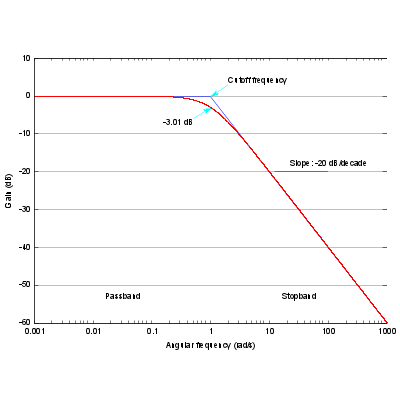
The image above represents a low pass filter’s frequency response. A DJ filter, when integrated into a mixer, is almost always, nowadays, a dual mode affair; the central detent is the off position and a clockwise and anti clockwise motion respectively take care of high and low pass filtering (the Vestax mixer in the header is an uncommon exception… but it’s a very pretty mixer so we thought it was worth the confusion. Allen & Heath have also traditionally used filters that switch modes with a button). ‘High pass’ and ‘low pass’ are pretty well termed in that they, as they are ramped up, have a progressively smaller guest list, so to speak, and the frequencies allowed through are whittled down until only the very lowest/highest are allowed past.

EQ, on the other hand, tends to have three ‘bands’ – think of them as areas of influence over frequencies in the track – but sometimes have two (ala the lower end Vestax PMC mixers) or even four (the Allen & Heath Xone 62/92, for instance), and the most notable thing that a DJ filter doesn’t do that the EQ section does is boost. All the filter does is reduce the amplitude of frequencies; turn your EQ clockwise and it will make the frequencies in its domain more powerful.

One of the big advantages to a filter is the way that there’s just the one knob to worry about. Mixing with a filter can be really subtle, because of the smoothness with which frequencies are added to (or taken away from) the mix.

Mixing with EQ brings with it the advantage of a high level of control, at the expense of the sweeping smoothness of a filter. Whilst it’s difficult to create a smooth sweeping frequency effect with channel EQ on account of the reality of dealing with a knob for every EQ band, it’s not only simpler to pinpoint a specific problem point or sweet spot with EQ but is the only way to isolate the mid range of your audio as well as both top and bottom end.


CHARACTER WITNESS
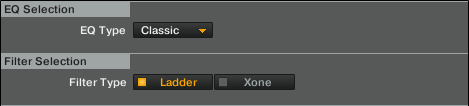
If all filters were born equal, then there’d be no arguments over who had the best – and we all know that’s not the case. A good DJ filter isn’t completely flat; a good DJ filter has character over and above simply ‘turning the sound down’. All the things that make one filter sound different to another are actually quite involved so we’ll leave the nitty gritty for another day,  but two of the big ones are steepness and resonance. The steeper a filter’s cutoff is, the harder frequencies are attenuated when they pass the threshold. An exceptionally steep filter will completely kill frequencies more or less as soon as they fall outside the cutoff point, whereas a gentler one will attenuate the frequencies smoothly as they’re cut out. This steepness curve is measured in dB per octave, and typically speaking DJ filters are quite, but not ruthlessly, steep. Resonance (often called Q) is the amount by which, just at the cusp of the cutoff point, frequencies are actually boosted with a little hump before they’re cut out. The more Q a filter has, the more of a warbly, ‘singing’ sound it creates as it’s turned, and this characterfulness creates two camps: those that love it, and the more the better, and those that hate it.

The smoother a filter, the more clinical and precise it is and thus the more accurate for using as a blend control, but at the same time the less musical it tends to sound. Different manufacturers and software developers give their filters different characteristics – and in this digital age, many are building in the opportunity to choose the style you prefer in settings.


TECHNIQUE
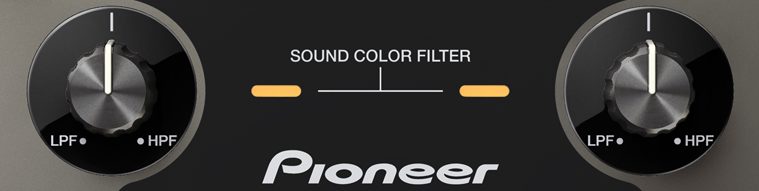
If you’re DJing with only the biggest, boldest, brightest confirmed dancefloor destroyers, and especially if they’ve never been out of the digital domain, using EQs for technical rather than creative reasons might be a foreign concept. If, however, your selections are a mixed bag of different eras, genres, formats – especially vinyl – and top-secret work in progress dubs, you’ll know that a little EQ goes a long way to bridging the gaps between how two tunes are mixed (and I mean mixed in the engineering sense here), and this is definitely the area in which EQ shines.

The ‘highs for high hats, mids for vocals and lows for bass’ mantra that many a DJ spits out whenever EQ is mentioned is a pretty big over-simplification, but it’s not one without foundations. Matching the levels of not just the general volume of the tracks you’re playing, but also their composition, will make for a smoother mix. Got some 80s house that just doesn’t thump as hard as 2011’s sonic pallet? Perhaps some bass is in order. The sound coming off your records a little harsh compared to the digital smoothness of your latest Beatport wavs? A little tweak to the mids should sort that out. You may even be the kind of perfectionist that, armed with the power to twist, stretch, and massage tracks, always has a hand hovering over the EQs to smooth out any changes in the tracks. But with all this technical tweaking, your EQ dials resembling the London/New York/Sydney world clocks in a high end board room, how do you fit in the creative frequency fiddling without losing your consistency? You guessed it.

DJ filters are, I’m fairly sure without exception, post-EQ (please let us know if you know any otherwise!). Whatever those EQ dials are doing, they’re doing it before the sound gets into the filter. This means that the filter’s effect on the track remains consistent no matter what’s going on up there, and so you can use the EQs to dial in the perfect character for the track – the setting at which all your tracks match each other tonally – and leave the filter to provide the artistic flair and frequency led mixing and blends.

TOP TEN TIPS FOR SUCCESSFUL SOUND SCULPTURE
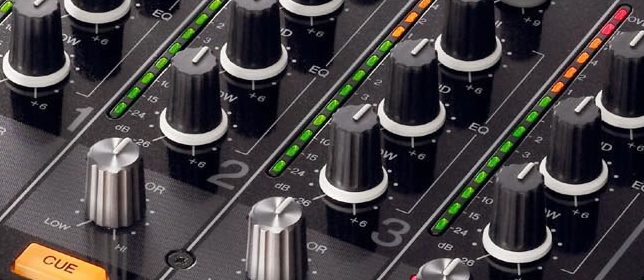
  • Don’t forget your gain when you EQ!
  • Use filters to allow you to make creative sweeps to the track and still be able to go back to the tuned EQ setting.
  • Experiment with the filter Q types available to you to find your favourite.
  • If you use a chunky Q, ride it rhythmically to get the track to ‘sing’!
  • If you don’t have filters available on your gear, practice using your EQs to get a sweeping effect by twisting the high, then high and mid, then mid and low, then low down to the bottom (or vice versa).
  • A filter sweep to bring a track in can sometimes sound a lot more natural than fading it in with the volume fader.
  • If you mix out by using filters, be wary of the filter not totally closing the track out; always finish a mix with a volume fader to avoid issues.
  • If your mixer doesn’t have mid EQ but you need some mid-range adjustment, try boosting high and low while cutting gain or vice versa.
  • Use filters for creative effect; ‘pump’ the filter rhythmically to make tracks wobble much more than an EQ tweak.
  • Remember: mix the overall sound of the tracks together with EQs, and then use filters to perform sweeps and blends.
Any tips of your own? Let us know!

I Loved This Article >


  • Loudist

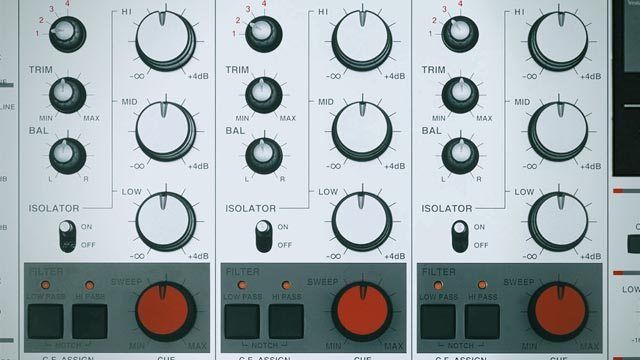
    What is the mixer, shown at the top of the article, with the red filter knob?

  • http://www.facebook.com/profile.php?id=1027810139 Janne Pulkkinen

    Some Vestax mixer, says in the text

  • http://www.djayggregator.com/2011/12/07/filter-vs-eq-which-when-why/ Filter VS EQ: Which, When, Why? | Djayggregator

    [...] Filter VS EQ: Which, When, Why? By DJayggregator on December 7, 2011 in Industry Newsletters Okay, if one was better than the other, top flight mixers would only have one – right? Yet it tends to be the cream of the crop that feature both. Why is this, and when should you be using which? BACK TO BASICS Not to confuse you, but EQs… Read more [...]

  • http://twitter.com/CharlesMykid Carlos Miniño

    Is a Vestax… dont know the model :p

  • Leytonangell

    vestax… cant remember model number

  • http://www.facebook.com/oakich Nikola ?oki?

    I hate Traktor’s deck filter, it has too much resonance, when you turn it to 2 o’clock it sounds soo sharp… The only issue with Traktor is the damn filter…

  • Jaymelis

    Vestax pmc-cx… Custom made to carl cox his needs. I think he still uses it, no idea. It’s an amazing mixer.

  • AndiD

    VESTAX PMC-CX (Google Image Search ;) )

  • http://www.eastendlideejay.com/DJNews/archives/89 Filter VS EQ: Which, When, Why?

    [...] Okay, if one was better than the other, top flight mixers would only have one – right? Yet it tends to be the cream of the crop that feature both. Why is this, and when should you be using which? BACK TO BASICS Not to confuse you, but EQs… Read more [...]

  • http://www.facebook.com/djstayinschool Martin Wilson

    I agree… Its one of the few things that makes me not want to ditch my 800 and just got S4. 

  • M Calica

    Its Carl Cox signature mixer from Vestax.  PMC-CX…

  • http://claimid.com/bartl Bart

    Switch filter type to Xone, the resonance there is a lot lower than in Ladder.

    Type your comment here.

  • Klaemo

    try switching it to the Xone filter, it’s much smoother than the Ladder filter.

  • Si Siddy

    Then go to the preferences and change it to the Xone type.

  • http://www.facebook.com/profile.php?id=100001945260195 Rg Tb

    “the most notable thing that a DJ filter doesn’t do that the EQ section
    does is boost. All the filter does is reduce the amplitude of
    frequencies”

    this is incorrect. high-resonance filters increase the volume around the cut-off point (whereas low-resonance filters decrease the volume at the cut-off point.)

  • http://www.facebook.com/people/Erik-Voit/194304527 Erik Voit

    Oh didn’t see the 23489348932498 other people that already said the same thing haha.

  • http://www.facebook.com/profile.php?id=100000531686375 Futureglue Musik

    Thanks for the article Chris.

    I love my Xone92 for the filter and 4 eqs. I know people bitch about 4eqs being overkill, but in the world of long house mixes 4 eqs is King. That extra low mid takes good care of the low synth without destroying the vocals or removes the sharpness of the bass. Sometimes I feel I’m mixing stems! Takes a while to master but worth the effort.  Mixing out with only eqs is really nice but you need full-kill eqs for that.

    Also the Xone eq action seems much nicer than anything Traktor has to offer (don’t get me started on the filter) which is too bad cause it means I’m stuck with lugging around that heavy mixer whenever I have a gig.

    One thing you didn’t mention is that eqs seem to be used more in the downward direction than up & “Bass is where the Volume is”

    cheers!

  • http://www.funkyhousemusic.com/2011/12/07/filter-vs-eq-which-when-why/ Filter VS EQ – Which, When, Why? | Funky House Music | FHMDC

    [...] Source: DJ TechTools [...]

  • DSharps

    Just wanted to say this is a very well written and interesting article! This is why I love DJTT. Thanks guys.

  • Max One

    The last traktor update fixed the filters imo, much less resonance. You running the latest version of Traktor Pro 2?

  • http://www.facebook.com/mynameisnotbilly Jamez Penson

    One new development that shold be mentioned is the Allen and Heath DB4 style EQ section that now lets you choose either between a “standard” Dj shelving style filter or having the 3 EQ controls running a LPF, a HPF and a resonance knob.

    In my mind this is absolutly genius, as I used to run Traktor 3 with a similar technique (using the filter with a low and high pass and a flat resonace to  mix between tracks instead of standard EQ) and it made for some much clearer mixes. UNFORTUNATLY Traktor decided to mess about with their filters for Traktor Pro/Pro 2 and now if you filter out the high frequencies there is a gain reduction which stops the LPF being even useable, :(

  • http://www.facebook.com/profile.php?id=1119907452 Taylor Schotter

    Than switch from laddar to zone modeled eq!!

  • http://www.ali.dj Hedgehog

    Regarding the post EQ-only filtering:

    The auto-effects on Pioneer’s DJM 2000 actually have three EQs themself to determine which freqency-band is affected by the effects.

    Therefore you are able to apply a filter-effect only to certain frequency-bands.

    This can be used very creatively to alter the groove of an existing track.

  • Livestrongstayhandsome

    Awesome Article!!

  • Anonymous

    Thanks for the good article Chris. Learned a lot!:-)

    scamo

  • http://www.facebook.com/the.electro.dreamr Dreamr O’Kelly

    Ahh, back to good articles!!!! Thanks Chris, well detailed. I admit, i’m a ladder filter nut!

  • Djpriz1

    Is there any way (using a third party program or not) to adjust the intensity of the superfilter on ns6 in it?

  • https://twitter.com/#!/hzaidi09 Hasan Zaidi

    But can’t you go to the settings and change the EQ/filter type to Xone? That’s what I’m currently using, and find it suits my style much better than the default setting.

  • http://twitter.com/WooDzMuzik Anthony Woodruffe

    I also think that because the Xone:92 is an analog mixer it really helps warm digital music.

  • M Calica

    vestax pmc-cx.  Carl Cox signature mixer…

  • M Calica

    I think he switched to the PMC-280, but lately I’ve seen him use the DJM-900(argh!!!)…

  • Anonymous

    Hi I’ve been using traktor pro since they came out and I love the filter
    xone on the version 1.1.1.001 they are the the best filter ever sounds
    insane and doesn’t cut off the sound with super amazing sound when u use
    as u know specially when u use the reverb T3 together Wow no words Its
    awesome filter ever ever . I always checked the new versions of traktor
    like the 1.2 but they changed the filters so I kept with old version
    just because of this filter using my vci 100. I’m disappointed because now I have the S4 with traktor 2
    and those filters come with it they are not good all when u use cut off
    the sound and doesn’t sound good thought. If is possible on the next
    update on traktor 2 add that filter on the effects so we can map them
    or as option on the filter selection. Please NATIVE INSTRUMENTS do that
    everyone will be so happy its the best filter ever and all of us need
    that. Do you guys remember this filter on traktor version 1.1.1.001? Nice article Chris thanks cheers…


  • Anonymous

    This article would have been so much better with some decent graphs. Didn’t think highly of the writing neither.

  • Anonymous

    Nice clear article, but I think it under-emphasises the use of EQ for blends. You can use them to ‘make space’ for the new track. For example one kick can sound quite different from another, and you can graduate the shift, or you can replace the bassline in one track (or sample) with that of another while letting the rest of the track continue, creating a much more layered mix. Indeed if you don’t reduce one bass before the next, the two bass lines simultaneously could be too hot, causing clipping and even speaker damage. You can use the filters to take out the bass by using them in high-pass mode, but EQs are a more flexible and smoother-sounding way. Two mids simultaneously can clash too, and sound over-powering, as the ‘lead’ of tracks tends to sit in the mid frequencies, (vocals, main riff, etc) and transitioning these can only be done with EQ. Same with hats, especially dnb which tends to have a lot of treble going on.

    Finally, filters are very powerful but even a smidgen of resonance has an audible character which colours the sound. If you’re going to manipulate the sound of your track, why not try using it in combination with FX – there’s a whole wealth of tricks there waiting to be let out the bag..

  • AGB

    Great article boys! Keep up the good work DJTT is my 1st stop for a DJ blog been following you guys for years now and you still cease to disappoint.

  • Frenchepaul
  • Travis Nyhoff.

    One example, that I can think of, of filter applying before eq is when djing w/ a soundcard and physical mixer. The filter would apply in your program of choice, and then routed out through your soundcard output and into the mixer where the eq would be applied before being sent through the master output to the stereo.

  • http://www.facebook.com/profile.php?id=1146584587 Mubeen Khan

    Not only can that practice make the feed too hot, but can also cancel phases for both songs. I always cut a band of frequencies before every mix and then slowly dial them back in.

  • http://www.facebook.com/profile.php?id=100000531686375 Futureglue Musik

    Actually those settings don’t sound at all like the xone mixer. Tony Andrews (of Funktion One) says they actually degrade the sound coming out of Traktor quite a bit.

  • http://ax11.myopenid.com/ Tom

    Wow. An interesting, insightful and pleasant to read article about *frequency filters* – certainly one of the most boring subjects one could imagine. Hell has frozen over!
    This is an outrage! The laws of physics are serious business after all. They are not to be taken as some cheap entertainment for the unwashed masses.

  • The BladeRunners

    Yes!
    There has never been anything as sweet as the v1 filter on Traktor!
    I keep that version installed just to mess with that filter knob.

  • Kyle Rayner

    “Remember: mix the overall sound of the tracks together with EQs, and then use filters to perform sweeps and blends.”

    I don’t agree at at all. I use the LPF HPF on the DJM800/900 to mix all the time. In fact, especially with dance music, if you are phrase mixing you can sync the build up of the new track with a HPF sweep of the old track. If done correctly the old record will suddenly “disappear” as the new one has dropped into it’s breakdown.

  • http://djlexlara.com/intro.cfm Harvey

    I have to agree with DSharps.  Interesting article

  • Menace

    in other words you do agree

  • Spiffy

    He mentioned that in the first paragraph of the Character Witness section.

  • http://www.djtechtools.com/2011/12/11/an-introduction-to-mixing-with-dj-isolator-mixers/ DJ TechTools  |  An Introduction To Mixing with DJ Isolators

    [...] a natural followup to last week’s article comparing filters and EQs, it’s time to take a closer look at the powerful audio devices [...]

  • PHILIPFRANCE

    Just realised you can blend with the filters !!!!  thanks DJTT

  • http://twitter.com/timmaughan Tim Maughan

    “DJ filters are, I’m fairly sure without exception, post-EQ (please let us know if you know any otherwise!)”

    One common exception: if your using filters within your DJ software, but the EQ on an external mixer…?

  • Tom_flynn

    I agree, really well written. I like to mix on both, but generally, i do as stated abouve 80% of the time, tweak my eq’s to get the desired sound for the track coming in & going out, then mix on the filter. I NEVER used to mix on the filters, i was a strict EQ only transition kinda guy, then i was showed how mixing on filters can really smooth things a lot better. 

    I guess just practice and have fun and experiment. 

    Oh, and i love me some resonance on my filters! I just love that sound. Not too much though!

  • Weißer Bart

    Load the Filter 92 effect into slots 1 and 2, assign one to each deck..  Hit button three, this toggles between modeled Xone 92 High and Low Pass Filters with Resonance and DJM mode, a dual mode filter with resonance.  Both of these filter types sound far superior to the Mixer filter.  In my opinion both the Ladder and Xone options are very poor.

  • Jorgelobo

    Please, a turorial for spanish comunity!!!

  • Jarvis Valko

    A question of signal-flow. When the audio signal passes the EQ on the external mixer after your software, then of course it’s processed after the filter.

  • Rishi

    Where can I find the technical information on Traktors EQ and Filter types?   I would be interested to see the difference between things like CLassic & P600 and Ladder & Xone.

  • Rishi

    Where can I find the technical information on Traktors EQ and Filter types?   I would be interested to see the difference between things like CLassic & P600 and Ladder & Xone.

  • xyz

    hey, is there also a german version of the artikel? would be nice ;)

  • xyz

    is there a german version of the artikle, too?

  • Morgan Sutherland

    Regarding the bit about filters being post-EQ, you should know that the order of the filters has no effect on the sound. This is proven by noting that a filter can be modeled by a linear time invariant system (LTI), which in turn can be represented as a convolution, which is a commutative operation.
    https://ccrma.stanford.edu/~jos/st/Filters_Convolution.htmlhttp://en.wikipedia.org/wiki/Commutative_propertyhttp://en.wikipedia.org/wiki/Convolution#Properties

    You can also think about it in terms of what is happening to the signal in the spectral domain. For instance, a low-pass filter cuts frequencies above 10khz and a high pass filter cuts frequencies below 15khz. It does’t matter which order we do this in, even though the filters “overlap”. Frequencies above 10khz are gone and frequencies below 15khz are gone just as 20 – 5 – 10 = 5 and 20 – 10 – 5 = 5.

  • Seth Levanen

    Really? As an intermediate to DJing, I thought this article was one of DJTT’s top reads. For me this is a concept I have yet to master and not many people around have been able to explain or teach to me. Personally, I felt they cut through this difficult material like a hot knife through butter and served it up – nice and creamy. This is HUGE for me and possibly many others out there. Reading this article is LITTERALLY opening a door to the next level of craft and creation for me as a DJ.  Thanks DJTT and thank YOU Mr. G.

  • Rez

    Also, in the analog sense it’s not actually providing active gain – which might be what he meant by boost.  It’s caused by the natural resonance of the circut.

  • Chiebs

    what is meant by “don’t forget your gain when you eq”?  Does it mean eq then check gain to make sure not clipping?

  • Thawizardofahhs

    You have to make up gain for what you may possibly lose in the bass.

    Not the steadfast reason I’m sure, but about 95% from applications that I would  come up with.

First Time?

This site is dedicated to digital DJs. We develop performance tools and teach cutting edge techniques that enable creative expression. Visit tutorial videos on youtube, equipment reviews in the blog and a very helpful community in the forum. New articles every Mon, Wed, Fri.

RSS DJ TechTools Forums

  • Wanted: Midi Fighter PRO
    I've been looking to buy a Midi Fighter PRO for ages! Not interested in 3Ds, Spectras or Classics! Inbox me if you're interested in selling, I am... […]
  • Worklog/Guide: Painting Technics SL-1200
    I bought two SL1200s that were in pretty rough condition, but I couldn't pass up the deal I got. Shout out to DjLiquitATL for giving me tips on... […]
  • Anybody got tips on getting started with producing tracks??
    I've been making my own personal mixes and sharing them with friends for a while now. I want to take a step forward and start producing my own... […]
  • speeding up pitch slider movement in Traktor
    Hi, I have my pitch sliders set to +/- 6% as it gives finer control - but the problem i'm having is it takes ages to get from say 121bpm to 125bpm... […]
  • Tweaker Help
    I'm extremely new to DJing. I was looking at buying the tweaker pretty soon, but I would just like to know if I can use it stand alone. Also, what... […]

DJ History: Spring 1979′s Issue of D.J. International

Read More...