A fader’s a fader, isn’t it? Well, no. A fader can run you back anything from the equivalent of a packet of sweets all the way up to a second hand car (not a very good one, admittedly, but still), and everything from their feel to their reliability and even what they’re actually capable of is at stake. Read on our little primer on just what it is you’re paying for.

VOLTAGE CONTROL

On most modern DJ mixers, the faders don’t directly control audio. Instead, they are used to create a value (usually by voltage control) which is then used by the amplifier section of the fader circuitry process volume (or indeed whatever else the fader is used for). This is great for audio quality, as it means that as the fader wears over time it’s only its ability to control the audio accurately that suffers, rather than the audio quality itself. If you’re planning on dusting off an old piece of kit that actually pushes the audio itself through the fader, you need to be aware that extra special attention needs to be paid to the fader’s physical condition.

Many mixers have circuitry that can dynamically alter the cut in curve, so that anything from a smooth gradient that takes half the fader’s length all the way down to a cut so sharp that it acts almost like a switch can be achieved. This is done by taking the values that are sent by the VCA circuitry for the fader and applying a ratio based calculation to them. When it comes to fader curve capability, MIDI is the great leveller. Because the VCA value can go into a MIDI circuit totally linearly and then the 0-127 MIDI values given any meaning at all, not only is VCA level curve control redundant on a device you’re designing with MIDI control in mind, but far less specialised faders can be used to achieve the same effects that require the most expensive faders in direct audio. Instant on/off is tough to achieve on a contact based fader because of the amp’s physical limitation when it comes to how quickly it can apply amplification to a signal over small amounts of change, but the same fader used to instruct a computer’s digital volume control can handle it with ease.
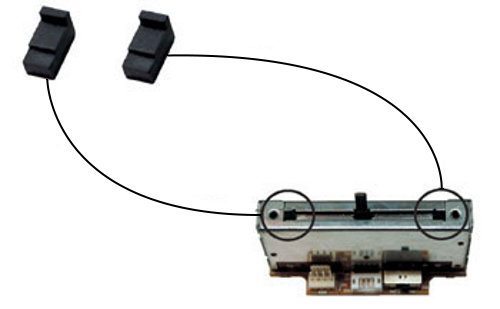
Feel aside, there are two big indicators of a fader’s quality: cut in and cut lag. Cut lag is the distance between the fader’s physical edge and the limits of its actual travel, and cut in is the distance it takes for the fader to go from off to on. Cut lag is a mechanical issue, and faders with a large amount of lag may ship as such to avoid issues with tolerance and reduce the preciseness of the manufacturing required, or may just be designed not to feel ‘twitchy’ if the use case they’re designed for isn’t end-to-end use. There are a number of ways around large lag, from manufacturer official methods – such as Vestax’s CLS-1 spacers that plug the gaps at the end of the fader – to good old homebrew mods involving scissors, credit card, and gaffer tape (and of course, if you’re anything like me, plasters/bandaids and tissues to mop up vital fluids spilled through inevitable careless snipping).

FADER TYPES

Carbon Track

  • Cheap
  • Small form factor
  • Can have a ‘grainy’ feel
  • Longevity issues

Examples: DJ mixers not designed for scratch markets, many MIDI controllers
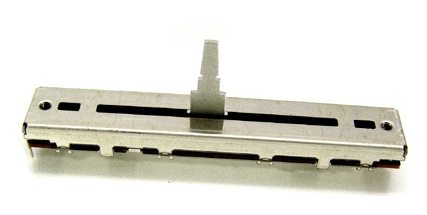
Low cost faders swipe a fader stem, which is held in place on a track not unlike cheap curtain rail, along a carbon track. The main problem with these faders is that their longevity is usually somewhat limited and the feel of the fader can be a bit sketchy, as carbon can become grainy in feel. However, they can be extremely cheap, which is a great cost saver for faders that don’t move much, have a miniscule form factor, and when you come out of the depths of the bargain bin carbon is used with newer, slide rail based design implementation in better mixers, too – including the Pioneer DJM900.

Conductive Plastic

  • Smooth feel
  • Long lasting
  • Require intermittent cleaning

Examples: Vestax PCV, Pro X Fade
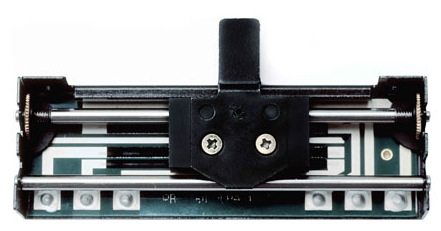
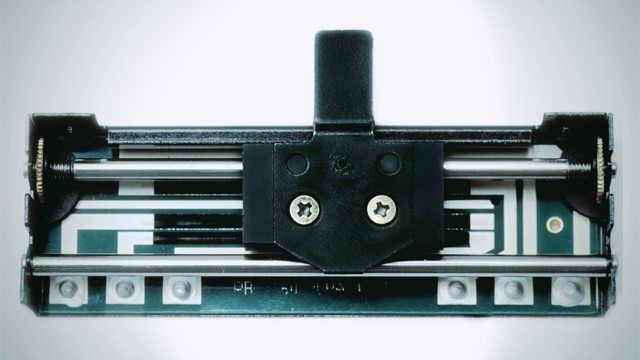
Conductive plastic has two big advantages over carbon: it’s more resistant to wear and it maintains a smoother feel. Most high end contact based faders use conductive plastic, and rather than directly dragging along a track below, the fader stem is connected to a main body that skates along rails whilst conductive prongs stick out and tickle the conductive track. This allows for a much smoother feel on the fader, as the rails can be lightly lubricated which allows the fader to slide smoothly, and the weight of the fader block itself provides a nice a nice inertial sensation. Unlike carbon track faders, which will wear out comparatively quickly due to failure of the parts, the longevity of conductive plastic faders means that there’s usually life in the fader after a clean is performed to maintain its smoothness.


When it comes to contactless faders, most share the rails based design idea that was established through contact fader technology because of the pleasant feel and low friction that the design provides. There are three main types of contactless faders found in the wild.

Optical Faders

  • Low cost, contactless technology
  • Most susceptible to environmental interference
  • Issues with accuracy in low cost designs

Examples: Focus Fader, Infinium fader
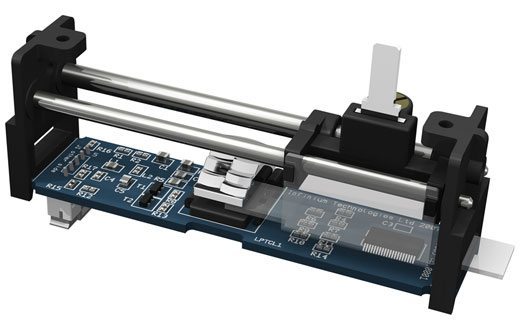
Optical faders are fairly low cost, but can be fragile and susceptible to environmental interference. Because they rely on optical sensors, anything that can potentially obscure the path of light and create false negatives, such as smoke and dirt, or fool the sensors and create false positives, such as disco lighting, can be a potential showstopper. Temperature can also have an effect on the fader, and actually create delays in response time. All optical faders are not created equal, too; the light sensing device can be designed as a photo resistor, transistor, or diode. Photo diodes are very quick and accurate, and thus perform very well, but they are much more expensive to implement than photo resistors. A photo resistor reacts quite slowly in comparison, and can lead to that ‘backwards spinning spokes’ effect where movement is not accurately transcribed.

Magnetic Faders

  • Accurate
  • Expensive
  • Smooth contactless technology

Examples: Rane Magnetic Fader, Ecler Eternal Fader
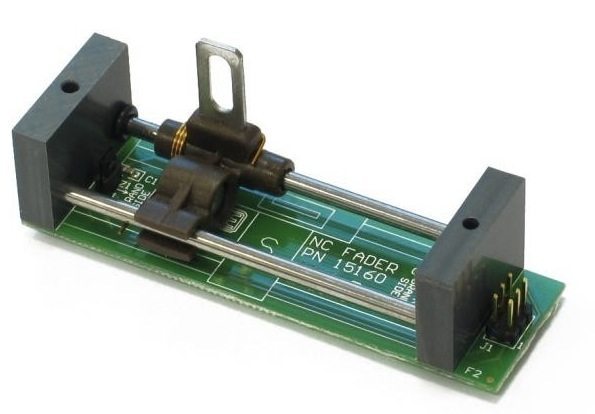
 

Magnetic faders create a voltage change based on the changing level of a magnetic field; sensors at either end of the fader track the position of the moving magnet attached to the fader stem. These faders are extremely accurate, and more or less impervious to environmental factors. However, they are also very expensive to develop.

Capacitance Faders

  • Accurate
  • Expensive
  • Smooth contactless technology

Examples: Innofader
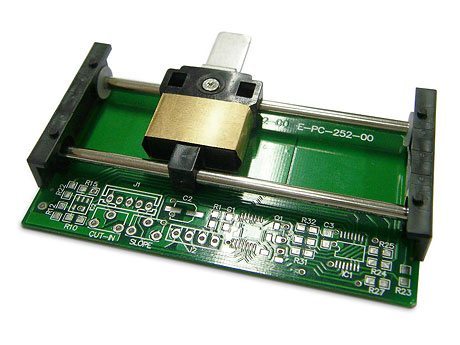
Capacitance based faders rely on the front and back walls of the fader housing, which contain circuitry that ‘reaches out’ to each other and creates a capacitive field that the fader block manipulates as it moves through. The quality of capacitive faders and magnetic faders is very similar, with both being extremely resistant to environmental influences.

MODS

One of the biggest issues for those of you considering modifying your equipment to upgrade faders is compatibility. One of the reasons that the Innofader is so expensive is because of the extensive research that has gone into providing compatibility with a wide range of mixers, as it’s not difficult to blow entire sections of your mixer or controller if you’re just jamming things in and hoping for the best.

When all’s said and done, faders are electrical components like any other, and compatibility is decided by the resistance of the fader along with power constraints – and, unfortunately, proprietary design when it comes to how the position of the fader is translated into the how the amp should amplify it. As there’s no real standard for wiring, you’ll also need to make sure that you’re not mixing up power rails. I’m sure we don’t need to state this, but keep an eye on the size of the fader you’re ordering too; it doesn’t take Will Hunting to figure out that a 60mm fader’s going to take more than a bit of clever arrangement to squeeze into a 45mm fader slot (although, of course, if you can make it fit some way or other the physical size isn’t nearly as big a consideration as resistance).

The bottom line is that you should do your research before you start modding in new faders into your kit – and that research may involve digging out your manual or scouring the internet for the schematics of the fader section – but switching a conductive plastic fader designed with scratch DJs in mind or even a non-contact fader can hugely improve the feel of your controllerism creation. Even better, if you’re putting a high quality fader into a circuit with MIDI functionality, you’ll be able to have the best of both worlds as the feel and longevity of the fader will go hand in hand with the flexibility of MIDI.

Editor’s note: Our Midi Fighter Pros‘ faders use a dual rail conductive plastic design – which we chose for longevity for all of you frantic fader freaks!  


  • http://www.facebook.com/djbassbitzsg Farhan Tahir

    S4 is using?

  • Sarasin

    LOL! This is DJTT teasing me….come on! HAHAHAHA

    I have been patiently waiting for my Innofader to arrive…..been 3 months.
    On the way to work….I am looking outside…its a PERFECT day!!! I think to myself that it could ONLY get better if my Fader arrives…
    So lets see….seeing this article is either a good sign….or omen!

    :)

  • Sarasin

    LOL! This is DJTT teasing me….come on! HAHAHAHA

    I have been patiently waiting for my Innofader to arrive…..been 3 months.
    On the way to work….I am looking outside…its a PERFECT day!!! I think to myself that it could ONLY get better if my Fader arrives…
    So lets see….seeing this article is either a good sign….or omen!

    :)

  • ivan zilch

    proud owner of the Rane TTM-56s here, magnetic faders all the way!

  • Guest

    Great article Chris, i always look forward to clicking through to yours and reading them. Keep it up! :)

  • http://www.facebook.com/profile.php?id=100001627127489 Miko?aj Boberto Bedzieszcierpi

    hi, have you any idea what model of fader can i use to replace orginal in numark mixtrack pro, was killed and need some to replace it, how i see it is a potentiometer, but i can mistake, can check a markings on it, but when i was try to find it  i can’t, and can’t find any informations about characteristics…

  • http://www.facebook.com/people/Mark-Doherty/100000474900038 Mark Doherty

    did it arrive  >?

  • Mork908

    Pioneer DJM T-1 is using?? Thanksss

  • Mylestec

    dope article Chris… you’re knowledge of these subjects is quite impressive.  Thanks!

  • str8updrew

    I love my Focus Fader V1(optical).  Never had any problems with interference.

  • Amy Bible

    What faders are used in the new midifighters?
    Ean?

  • http://www.techbuzzing.com/2011/11/dj-techtools-fader-technology-a-primer/ DJ TechTools | Fader Technology: A Primer | Tech Buzzing

    [...] the original post here: DJ TechTools | Fader Technology: A Primer Related PostsNovember 2, 2011 — Cognizant Technology Solutions Corp Earnings [...]

  • http://www.impartme.com/technology/gadgets-technology/2011/11/dj-techtools-fader-technology-a-primer/ DJ TechTools | Fader Technology: A Primer « ImpartMe

    [...] More: DJ TechTools | Fader Technology: A Primer Tags : accessories, article, audio, author, chris-cartledge, fader, hunting, manufacturing, [...]

  • Quenepas

    im pretty sure it is the cheap one. I cant wait to bust it and get an innofader :p

  • Rhoades_kevin

    I own 2 innofaders and one Pro-X fade, I’ve tried them all from TTM57 to DJM909 to the ecler eternal, and realized that the price set back of the innofader is less an issue when it comes to compatibility and installation. Innofader provides personnalised service, when you have issues and write to support@audioinnovat.com it’s actualy Eliot Marx himself who coaches you trough your install. The other great thing is that it can fit 100$ mixer like it can fit a 3000$ one. If your a scratch nut like me, the innofader is the only way, do to it’s compatibility with all mixers…..

  • Rhoades_kevin
  • Chris Cartledge

    Thanks, Guest!

  • Chris Cartledge

    Thanks, Guest!

  • Chris Cartledge

    Thanks, Guest!

  • Chris Cartledge

    If I recall correctly, it’s a proprietary optical design that was developed for the 707/909 range. It’s a much better fader than the ‘x00′ range of Pioneer mixers. 

  • Chris Cartledge

    If I recall correctly, it’s a proprietary optical design that was developed for the 707/909 range. It’s a much better fader than the ‘x00′ range of Pioneer mixers. 

  • Chris Cartledge

    Thanks Mylestec! Let us know if you’ve any ponderings you’d like to read future articles on!

  • Chris Cartledge

    Thanks Mylestec! Let us know if you’ve any ponderings you’d like to read future articles on!

  • Chris Cartledge

    Thanks Mylestec! Let us know if you’ve any ponderings you’d like to read future articles on!

  • LeFresh

    I bought an innofader pro after my penny & giles fader broke off. Its the most amazing fader I’ve ever used.

  • http://www.funkyhousemusic.com/2011/11/08/fader-technology-a-primer/ Fader Technology: A Primer | Funky House Music | FHMDC

    [...] Source: DJ TechTools [...]

  • http://twitter.com/reyvaldes r3y vald3s

    Just got my Innofaders for my VCI-300 and Vestax 05. Thanks DDTT

  • http://twitter.com/reyvaldes r3y vald3s

    Just got my Innofaders for my VCI-300 and Vestax 05. Thanks DDTT

  • http://twitter.com/reyvaldes r3y vald3s

    Just got my Innofaders for my VCI-300 and Vestax 05. Thanks DDTT

  • http://twitter.com/reyvaldes r3y vald3s

    Why so long? Mine came in less than a week.

  • http://twitter.com/reyvaldes r3y vald3s

    Why so long? Mine came in less than a week.

  • http://twitter.com/reyvaldes r3y vald3s

    Why so long? Mine came in less than a week.

  • http://twitter.com/MOYMA MOYMA

     I have had a Rane 56 for about 7 years…no problems at all. 

  • http://djtechenspanish.com/2011/11/20/tecnologia-de-faders-entiendelos-para-dominarlos/ Tecnología de Faders; Entiéndelos para dominarlos « dj tech tools en español

    [...] Djtechtools.com GA_googleAddAttr("AdOpt", "1"); GA_googleAddAttr("Origin", "other"); [...]

  • http://www.djban.com.br/noticias/faders/ DJBan – O que você sabe sobre faders?

    [...] originalmente publicada pelo blog DJ TechTools. Traduzida e adaptada por Thiago de [...]

  • http://www.djtechtools.com/2011/11/29/upgrade-your-kontrol-s4-with-the-innofader-innobender/ DJ TechTools  |  Upgrade your Kontrol S4 with the Innofader (Innobender)

    [...] For the scope of this article you will see use the “Innofader” and Innobender interchangeably. Innofader is the overall product line and the Innobender is the specific edition of the Innofader for the S4 (amongst others). If the whole subject of faders is new to you, be sure to check out  Fader Technology: A Primer. [...]

  • http://www.digitaldjtips.com/2011/12/over-to-you-how-to-fix-a-noisy-crossfader/ Over To You: How To Fix A Noisy Crossfader? | Digital DJ Tips

    [...] unhealthily interested in the myriad types of crossfader out there, DJ TechTools carried a crossfader article detailing them [...]

  • http://twitter.com/Innofader Innofader

    Actually there are two types of conductive plastic faders – one is straight conductive plastic (CP) and the other one is carbonized conductive plastic (CCP). Vestax faders use CCP technology (as do their offshoots Denon Flex Fader and Numark CP Pro) and the Pro X Fade is CP technology. 

    The difference – CP faders might last longer but require a lot more cleaning. On our AEM-100/i mixers with the Pro X Fade, the #1 service issue was DJs who didn’t stick to the 1x/week cleaning regimen ended up with bleeding faders that started to feel like glue.

    And about Innofader installation issues, most of these are due to people just shorting the thing out by accident, or trying to “hot swap” the device while the mixer is on. For the standard Innofader model and Innobender, the mixers and controllers we specify it for definitely have compatible circuits. Regarding the Innofader Pro, the circuitry is designed as such so that it can handle virtually any crazy circuit that manufacturers throw at it.

  • Jeremy

    What fader technology does Vestax’s cf-x2 (in pmc 05 mk4 and upgradeable for vci 300, 380 and 400) use?

  • Dj Focus

    Dj Focus here…How did I get here? Since I am officially back in active duty, I’d like to add my two cents. First in regards to the optical portion of this page.

    Absolutely, nobody uses a Photo Resistor because they have a very slow Rise and Fall Time As a matter of fact my first attempt at a Con-tactless Fader was with a Photo Resistor and then I moved to IR. Why would it be mentioned in this page at all, is the writer just wikismart with no soldering iron burn marks :-)…

    Second The first “Focus Fader” was an Alps Fader modified with the Optical Transmitter Receiver Pair and it is still working to this day, the strobe lights only made the Cute Girls Hotter at the Club, Dust and Smoke? Mute point because the Beauty of Contacless Fader and especially the “Focus Fader” is that it can be opened and cleaned but I would not recommend Performing in a Dust Storm too much Sand or Burning Building too much smoke….

    The day The “Focus Fader” was created was the day Static and Bleeding disappeared from the vocabulary of Djing and Scratching.

    Also from day one it was called “True-Optical”, “Contactless” and “Version 1.0″ to allow room for growth.

    Have I used a Hall Effect Sensor before after the fact? Yes, I have, was it necessary? Nope, not for Scratching…

    Another note to mention is that because the “Focus Fader” had minimal parts it was able to be brought to market at a reasonable price actually way below the 120$ for a regular Carbon Vestax Alps Fader at the time…Let’s keep things in perspective, this was 1998 when the “Focus Fader” was first created, You had High priced Vestax and low cost Gemini running the show…I come from humble beginnings and it was as much for my use as it was for the Turntablist Scene at the time…

    The fact that it existed pushed competitors into creating their own versions as the story goes one of the companies you listed told me over the phone “Why would we create a fader that doesn’t wear out” after the fact, they created it because market pressure demanded it.

    My question is why is the “Focus Fader” on the low list and at the end you mention using a regular double rail fader. That can only mean it is a Bourns or Noble Fader similar to what Gemini uses and can be bought through Mouser Electronics :-)

    In closing, I haven’t been associated with Stanton in years and my intent is to bring balance to this conversation.

    This read like a typical marketing tactics in sheeps clothing, Give information to create credibility and build reader confidence, lower value of x items and raise value of z items.

    Looks like Innofader has taken over which is ok since I don’t have any association the Stanton anymore.

    It is still a matter of fader preference though and I don’t hear anyone that uses the Innofader doing anything more spectacular then with a Pro X fade, “Focus Fader” “Infinity Fader” keep in mind my perspective is that of a Scratch Dj/Turntablist since 1986…Feel free to follow me on Facebook…If you have any questions or for the latest Fader News :-).

    Ps. Elliot I am still waiting on that Prototype from 2007 you were going to send me, What changed? :-) Send me 2 or 3 for my Zendo…Yup, Focus is back….:-)

  • colossus808e

    Manufacturers purposely built faders to fail back in the nineties, when I started, so they’d recieve a stream of revenue from replacement parts continually being bought.

    I can’t remember how many Vestax Alps faders I went through in a two-year period; something like 4: the fader stems would bend and eventually break off (fader prongs were cheap metals with two prongs, prone to bending and eventually breaking, even after I would fill the middle with cement epoxy), or the fader would bleed and no longer cut.

    Your Focus Fader was a great idea, and would have been better… if Stanton had built them to last as they had advertised: “scratch for weeks, months, and years with no bleeding” …they had said. I purchased one, and it broke after a short time because the metal tab part that would go between the sensors first became unglued from the impact of skratching, and fell off. I crazy glued it back on, then the tab completely broke in half a short time later. I epoxied it back on, the best I could, then the rail on the focus fader broke, and my rail caved in. I’ve used Vestax PCVs for years after that, with no durability issues; they were built to last. I’ve recently purchased an innofader and I hope the build issue is up to par; (it hasn’t arrived yet).

  • colossus808e

    I forgot to mention Stanton’s cheap, built to break fader caps, which I used to have to fill in the gaps with epoxy to make them not prone to breaking. Ah, I’m sure glad those days are done!

First Time?

This site is dedicated to digital DJs. We develop performance tools and teach cutting edge techniques that enable creative expression. Visit tutorial videos on youtube, equipment reviews in the blog and a very helpful community in the forum. New articles every Mon, Wed, Fri.

RSS DJ TechTools Forums

Review: Hot Hand USB Wireless MIDI Controller

When it comes to MIDI controllers, physical motion can be a hard type of input to understand and access - especially when it's completely disconnected from a physical controller. What if there was a controller that simplified motion - not quite as complex as Read More...