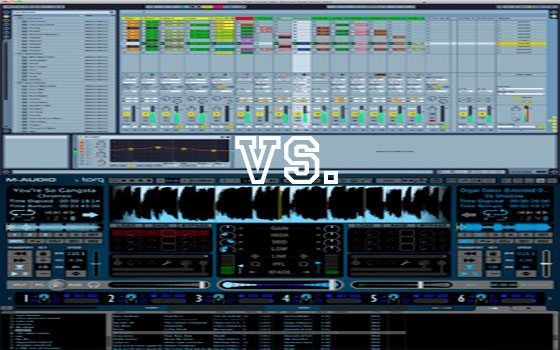
Time-Stretch Comparison: Live/Traktor Pro/Serato/Torq
You asked; we listened. Our article comparing the time-stretching/compression algorithms in M-Audio Torq 1.5 and Ableton Live 8 has been updated to include Trackor Pro and Serato Itch (which includes the same algorithm as Scratch Live). How much of a difference is there? We ran some tests and let you hear and decide for yourself after the jump.
FANTASTIQUE ELASTIQUE
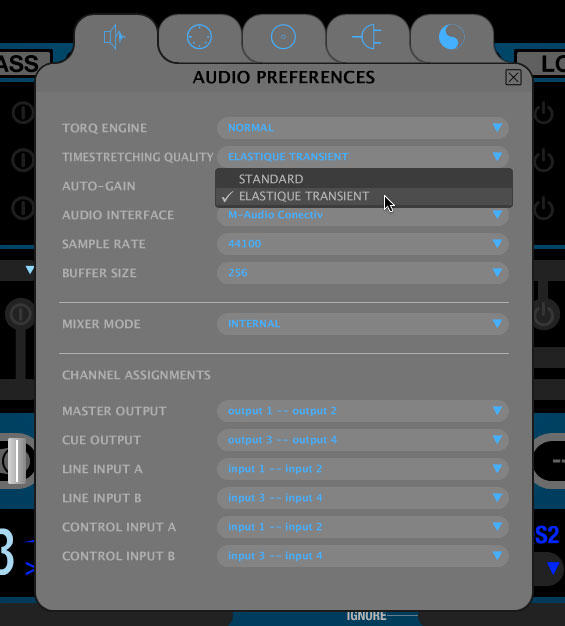
Most of these programs use versions of Zplane’s highly-regarded Elastique time-stretching/compression algorithm. The Torq 1.5 update earlier this year added the “Elastique Transient” option, selectable from its Timestretching Quality preferences. Also this year, Ableton Live 8 added a Complex Pro Warp mode, which uses Zplane’s Elastique Pro. Traktor Pro has used Elastique for a while, but it’s recent 1.2 update enhanced the quality of it’s HiQ mode from the Elastique Efficient algorithm that was in Traktor 1.1. Only Serato currently does not use an Elastique algorithm because Serato makes it own respected Pitch ‘n’ Time technology for time-stretching/compression.
DJ SHADOW – “ORGAN DONOR” ORIGINAL (110 BPM)
We chose DJ Shadow’s “Organ Donor,” which at its 110 BPM original tempo, could conceivably be sped well up or slow way down during a set. We also included a couple of examples of Torq’s Standard time-stretching mode, to show the difference between its better Elastique algorithm. The following tests were all recorded with key-lock turned on. Listen for yourself to decide who’s the king.
DJ SHADOW – “ORGAN DONOR” + 27.2% (140 BPM)
A- Torq 1.5 Elastique
B- Torq 1.5 Standard
C- Live 8 Complex Pro Warp mode
D- Traktor Pro HiQ/Fast CPU settings
E- Serato Itch (same algorithm as Serato Scratch)
DJ SHADOW – “ORGAN DONOR” – 27.2% (80 BPM)
A- Torq 1.5 Elastique
B- Torq 1.5 Standard
C- Live 8 Complex Pro Warp mode
D- Traktor Pro HiQ/Fast CPU settings
E- Serato Itch (same algorithm as Serato Scratch


November 9th, 2009 at 9:24 am Quote
Well, I think it’s kind of unneccesary for torq to have a ‘better’ timestretching, cause a dj will never slow or speed up a song that drastically, think thats why you can choose it as an option, in ableton, thats another case, then sometimes it may happen when extracting a sample, you want it to go slower,… It would’ve been nice if you included serato and traktor, but I dont stretch that much so no prob
November 9th, 2009 at 9:39 am Quote
I imagine Traktor and Serato were not in the comparison because there’s no contest there.
Awesome post DJTT!
November 9th, 2009 at 10:14 am Quote
Serato itch time streching is so bad its almost funny. It barley makes it past -5 by the time it gets to -10 u think someone has it in a choke hold.
November 9th, 2009 at 10:18 am Quote
LOL was thinking the same thing about Traktor
November 9th, 2009 at 10:51 am Quote
Beautiful Ean, those comparative posts are awesome for us, keep the imparciality like you did now and we will keep coming to this blog and forum to comment.
Many thanks!
November 9th, 2009 at 10:52 am Quote
eeeerrrr not Ean, it’s a markkus post.
Sorry for that again hehehe
you guys should put the post author bigger in the entry. :(
November 9th, 2009 at 12:00 pm Quote
Traktors keylock sucks I dont use it.
November 9th, 2009 at 12:04 pm Quote
Oh really? Taking 160bpm breaks and layering them under downtempo strings is a favorite trick of mine. Sure, if you’re doing a floorfiller set you’ll stick around the same 130-150 BPM, but for downtempo and ambient noodlings anything goes. Try a daytrip outside of your genre once in a while, it’s good for the soul.
November 9th, 2009 at 12:09 pm Quote
I was JUST talking to another DJ last night after work about this topic!!!
I told him I didn’t like the sound of the Keylock (master tempo) in Traktor Pro. It sounds like the kick is just squashed and makes the track sound muddy. I’ve tried it in the club, its night and day. So I leave the Keylock off, and It sounds great and punchy, but I can’t really adjust a track past +3.5% if its a vocal track, so thats really restricting. On Pioneer CDJ-1000mk3, the timestretch with master tempo on sounds awesome, so its not a problem there.
He said “Torq is the best for timestrech, blows Traktor and Serato away.” Told me he’s got a XPonnent and feels free to go all over with tempos with the Keylock on. So I was researching buying a Connectiv when I got home, so I could try Torq 1.5
I would love a test with Traktor, Serato, and Torq using different styles of music, and stretched only about +5 or +6 max, and with turning the Keylock on and off, so get a real sense of the sound quality.
November 9th, 2009 at 2:34 pm Quote
related topic .. didnt torq also get the ability to handle variable BPM’s?
November 9th, 2009 at 3:30 pm Quote
Were the test done with keylock on with Torq? Good job markkus on previous articles!
November 9th, 2009 at 3:37 pm Quote
I don’t use either software, but I am curious about Ableton (but not right now)… Though I do agree with the rest of the commenters, it would be nice to see some serato v. traktor posts. I think the majority of ppl here uses one of those two softwares…
November 9th, 2009 at 4:16 pm Quote
You can only hear the tempo change, not the pitch, so yes it was done with key lock on ;)
November 9th, 2009 at 4:32 pm Quote
Bring on the Serato vs. Traktor! Gloves off!
Thank you for the practical, impartial comparison. It is very educational. Makes me feel sad to be using Traktor and trying to mix varying genres with keylock on. If somebody had told me that Torq had better timestretching (or Ableton, for that matter) before I got addicted to having a certain set of functionality, I would have gone another route (though I might not have bought a VCI-100SE, and that would be a shame :P ).
Anyway, thanks! Looking forward to hearing about Traktor and Serato.
November 9th, 2009 at 4:54 pm Quote
Love the Torq posts!!! More Please!!!
November 9th, 2009 at 6:33 pm Quote
I agree, it’s good to see posts about things besides Vestax and Traktor, it takes all kinds!
I’d really like to see a post about recommended MIDI layouts for the Xponent, if that’s what you’re using markkus, because most people who use it don’t jump far from the original layout. I’d really like to see if there are any interesting tricks you can pull off inside Torq with things like combining loops and the new chained effects with MIDI.
November 9th, 2009 at 6:53 pm Quote
Ableton has had complex warp mode since at least Ableton 7. In fact, it’s the reason for this awesome bug that causes it to crash in Snow Leopard :(
http://forum.ableton.com/viewtopic.php?f=1&t=123598
November 9th, 2009 at 6:58 pm Quote
Hey everybody:
We listened to many of your suggestions and added Traktor Pro and Serato to the party. This post is a bit of a different beast now, but the spirit is the same. Thanks for all your comments; some of them I deleted as they no longer pertain to the updated article. No offense to those people! We love the lot of ya.
November 9th, 2009 at 7:23 pm Quote
Evan: I meant to say Complex Pro Warp Mode, which is in fact new in Live 8 and is an upgrade to the Elastique Pro algorithm. They have also kept Complex mode in Live 8, and they claimed to have fixed that bug for 8. However, I haven’t installed Live yet on my Snow Leopard machine, so I don’t know for sure–sorry.
November 9th, 2009 at 7:45 pm Quote
Wow.. Impressive update speed. Great article Markkus.
The artefacts introduced by Serato’s algorithm is scary.
Traktor really sorted itself out when they fixed the Elastique algorithm. HiQ mode is all I use, even though they used to suggest you use ECO mode when spinning on Vinyl timecode.
Anyway, cheers for the update. Look forward to your next article.
November 9th, 2009 at 8:07 pm Quote
I think Traktor won both tests.
November 9th, 2009 at 8:36 pm Quote
traktor won both tests but on the second one is clear that ableton is 90% there
November 10th, 2009 at 1:04 am Quote
Great article, thx for it really enjoyed the read.
November 10th, 2009 at 1:36 am Quote
TRAKTOR WON!!
November 10th, 2009 at 3:00 am Quote
Then you probably should upgrade to Traktor Pro 1.1… ;)
November 10th, 2009 at 5:33 am Quote
1.2 now
November 10th, 2009 at 5:46 am Quote
Talk about a creativity destroyer. I thought I was the only one this happened to. I thought Ableton said everything was fine in Snow Leopard.
November 10th, 2009 at 8:42 am Quote
Traktor Pro takes it. Looks like the Elastique Pro is a decent bit of kit. Ableton is nearly there. Torq isn’t bad, a bit grainy when slowing down. Elastique better than standard. Serato did not sound good.
November 10th, 2009 at 10:26 am Quote
i think the torq standard and the serato timestretch are worst by far.
November 10th, 2009 at 11:11 am Quote
At last someone’s done a decent comparison. Well done guys.
Also nice to see that Prztz agrees; I’m a huge fan of his work and had no idea he read this site.
November 10th, 2009 at 11:23 am Quote
It definately comes down to Torq Elastique and Traktor, I’m leaning more towards Torq Elastique (I’m a Traktor user) for the fast tempo, but Traktor for the slow tempo, Traktor has more punch than Torq
November 10th, 2009 at 12:34 pm Quote
Markkus thank you for your write up. The only snag I see is that one might get different results using different genres but this a great start.
November 10th, 2009 at 12:55 pm Quote
I did, it’s a bit better but still doesn’t cut it, no keylock for me!
November 10th, 2009 at 2:10 pm Quote
I own torq, traktor and serato, and I can say that traktor its the best by far but you get distortion when you pitch bend, you barely notice it on dance music but other styles you will really hear it and that’s something you don’t get with serato. I currently use serato and yes its worst but I learned how to work arround the limitations, just don’t go + or – 2% and try to bring it back to 0 as soon as you finish the mix.
November 10th, 2009 at 2:37 pm Quote
Actually, I’d love to hear a comparison between Pioneer’s timestretching and that which is found in the various audio apps discussed in the posts above.
November 10th, 2009 at 2:40 pm Quote
Oh and very nice update @markkus. Makes it much easier to do side by side comparisons !
November 10th, 2009 at 4:20 pm Quote
@Pepehouse
Do you have it on Hi-Q mode, the economy mode sounds aweful, snares break up at like -2%
November 10th, 2009 at 5:51 pm Quote
EXACTLY! Surely someone has a CDJ out there and can do this? I’m really intrigued to see if software is holding it’s own against hardware solutions.
November 10th, 2009 at 9:49 pm Quote
I do love the zplane algorhythm (HA see what i did there!) I am digging the more comparative features of your posts markkus. Its good to see a variety here. I think alot of us spending our time out here in the blogosphere are looking for these things to either reassure us of our purchase or to help us make one. More software, more hardware, more tips, sadly you guys cant give us more time.
November 11th, 2009 at 5:00 am Quote
Unbelievable!
I could just listen to it through the macbook speakers. But still, the difference in the Ableton version compared to the other software is exactly what I hear all the when I’m sampling in Ableton: There’s a big lack of low frequencies and all the punch gets lost. All the time I’m messing with Ableton to “fix” that lack of sound. It’s really frustrating to see that the software is my problem, since it is my weapon of choice production wise.
November 11th, 2009 at 7:44 am Quote
Good approach! I may add some few criticisms as I’m familiar with conducting scientific listening tests:
- Are you making sure that all samples have the same “perceived loudness”? I’m sure that some are definitely quieter than others. This can make a huge difference to the judgement (”louder=better problem”).
- Use shorter sample lengths. It’s hard to (objectively) compare samples of 20 seconds length. A maximum length of 8-10 seconds is regarded as standard in psychoacoustic literature.
- It would have been cleverer NOT to put the names of the products right next to the samples. I myself noticed that as a listener you are always somehow biased in a direction of personal preference. Would have been funny to let people choose the ranking of samples and then make a small statistical postprocesing of results and put it online afterwards ;-)
My personal feeling to this topic is, that I can’t understand people mainly complaining about Traktors algorithm. At some point any algorithm will sound crap. I’d also appreciate a sample set with the results from a recent CDJ400/1000. I think this should clear up a lot of myths going ’round in the community. It’s a complex field with a lot of weird signal processing going on. But all brands have the same technical approaches and troubles to fight with. There is no special “magic” with certain products, be it software or hardware. Keeping some sort of objectivness is vital to make fair judgements…
Thanks for the article!
November 11th, 2009 at 8:15 am Quote
Serato and Zplane s*ck, the only time stretching that can be used for hi quality processing is Dirac, Serato creates too many phasiness artifacts and zplane sounds too grainy. I use time stretching on a daily basis and it’s sad to see that you left Dirac (Timefactory) out of the equation. Definitely the best time stretching for DJing… just my 2 cents, –th
November 11th, 2009 at 12:32 pm Quote
i love timefactory for my studio work, but which dj app uses this Dirac algorithm?
November 12th, 2009 at 3:26 am Quote
all right abelton users if your using abelton to dj with and you have multiple tracks warped and time stretched you can change to complex in the wave form menu to the side on the bottom. complex setting uses more cpu so if your layering say a vocal track with say a drum loop and a synth try complex for the vocal track and set your others to beats it will save cpu especially when you start layering effects at least it seems to work for me . (abelton seven,dell 1526 2gb ram 120gb memory,technics1200m3d,rane ttm 56,audio kontrol 1 interface.)
November 12th, 2009 at 3:50 pm Quote
Funny how everyone has different answers to the time stretch testing. I’d like to see more in-depth testing with this issue because I have found that Traktor Pro’s time stretch to be really awful and Serato’s to be perfect in my experience. But listening to the testing, Traktor beats Serato. MAybe try the testing with different genres of music as well as with WAVs vs Mp3’s timestretching in the testing
November 12th, 2009 at 8:47 pm Quote
Very nice! Finally something on a DJ site that’s actually about how stuff sounds, not just what it does, how easy, well, etcetera, etcetera.
The 80 BPM for Serato Itch is downright embarassing. None of them are great – they alter tonal balance dramatically, change stereo imaging – from some stage width on the original to a sometimes dead-center-almost-mono on some – and make things sound grainy. If I could download it, I’d get some snapshots of the files. I bet the difference is plenty visible.
November 13th, 2009 at 5:51 pm Quote
Traktor’s timestretching is decent, but is absolute horseshit when it comes to squarewaves.. no way around it. I don’t have any personal experience to contribute towards the other programs, but I’m hugely disappointed by the algorithm’s ability to handle square and sawtooth synths.
November 14th, 2009 at 8:01 am Quote
I’m suprizesd that Serato sounds like this.
I used Pitch’n'Time in film industry, and it was best of stretch audio engine. Is Serato Ich so bad?
November 14th, 2009 at 8:32 am Quote
Traktor won both by far.
Torq Elastique quite good though it lacks brightness, but doesn’t make a wah wah sound in the wave when speeding nor “double kick” when slowing.
Ableton does both – destroy the synth when speeding and double the drums when slowing. Which is sad cause it’s mys soft of choice and I do hear it a lot especially on basslines.
When I though Torq normal wasn’t even worth listening to, Seato comes and win the competition by far of the worst one when it slows down (wtf was that?).
Also used pitch and time for a long time in sound design industry, and… Idk, maybe when it comes to post rendering it does great, it only sucks real-time. Cause it’s way better to speed up or slow down something with pitch ‘n’ time on PT than at Ableton (voices, Fx, voiceover etc).
November 15th, 2009 at 5:50 pm Quote
I’m wondering if the Traktor really was in HiQ-mode on the 80BPM test… reason being, the output sounds like the old (pre-1.2) HiQ algorithm. With the new algorithm I can go almost to -50% before the sound artifacts come audible as clearly as they did on the example you’ve posted (I admit that I didn’t download the file myself and try it, so your mileage may vary from mine).
I would also have been interested in hearing the new Propellerhead “Record” alongside the others. Granted, their time stretching is not realtime, but it is the best one I’ve heard so far… and I’ve understood that they use their own system for stretching instead of relying on “third party package” like elastique.
November 18th, 2009 at 1:33 pm Quote
+/- 27% is really extreme. to me it’d be more important which algorithm is the best at, say, +/-3%, cause that’s what djs use.
November 19th, 2009 at 8:31 am Quote
tracktor pro sounds like it was recorded a little louder than the others
November 20th, 2009 at 5:46 pm Quote
Hmm. Sounds rigged to me. The traktor sample is obviously louder than the rest to bring out the dynamic qualities. Who knows what other processing was applied to make things sound better (or worse). Traktor Promo. Nothing against it, but just say…
November 21st, 2009 at 8:14 pm Quote
The Serato algorithm sounds worse than traktor scratch with a super dusty needle or a computer glitch. Absolutely terrible. Guess that’s why I use traktor haha.
November 21st, 2009 at 9:23 pm Quote
Rubbish. Just saying…
November 24th, 2009 at 1:31 pm Quote
serato sounds like it got pwnd to me…
November 30th, 2009 at 12:47 pm Quote
You should have done a “blind” test (without the name of the software) in order to avoid bad results (= people influenced by the name) and give results just after the vote. When you have to judge a time-stretch algorithm either you have the engineering tools/knownledges or you have let’s call it “professional” ears (which is not the case of all the people on Earth).
December 7th, 2009 at 10:18 pm Quote
Stop worrying about how loud this sht is. The quality of Serato’s time stretch -27.2% is absolutely terrible. There is no question here. Some Serato fanboys are willing to ignore the fact that sounds terrible.
December 7th, 2009 at 10:21 pm Quote
@Basie:
You’re right. Pitch in Time was fantastic. The difference is, this is real time.
December 11th, 2009 at 2:15 pm Quote
January 4th, 2010 at 7:54 pm Quote
for me, when it comes to reduce bpm its:
1º torq elastique
2º traktor
3º ableton
4º torq standard
5º by far: itch
have no words for increase bpm
January 17th, 2010 at 3:03 am Quote
Has anyone here tried out the new Virtual DJ 6.06 Pro New Year Edition? Yes it is very basic when compared to Traktor,(I got both),but it does allow video mixing and beat matching the same as with just audio.With a dedicated output for a second video monitor as well.
The beat engine is different than that in Traktor for many songs for some reason but the sound quality is just shy of Traktor now.It has come along way.
I use Traktor for live shows and Virtual DJ for recording.Just wondering what you guys think?
February 9th, 2010 at 1:38 pm Quote
Great article! Although they are not as commonly used by DJ’s, both Pro Tools and Mixmeister also offer pitch shifting/time stretching. Perhaps they can be included in the next comparison.