Key Analysis Software Smackdown

KeySoftwareSmack3

As big proponents of harmonic mixing, the DJ TechTools staff started out with a simple question: which program that analyzes a song’s key gives the most accurate results? To find out, we looked up the keys using sheet music for a selection of 50 pop/rock songs and then analyzed those songs using four key-detecting apps: BeaTunes 2, Mixed In Key 4, MixMeister Fusion and Rapid Evolution 2. Read on to find out the results.
camelotHarmonicMixingTHE KEY MAKERS

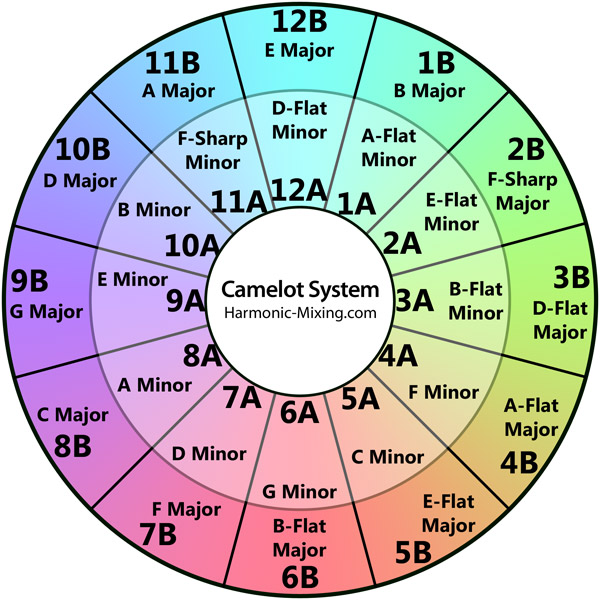
For our 50 test songs comprising recent hits and vintage classics (in MP3 and AAC formats), I took the keys from the digital sheet music site MusicNotes.com and compared those keys with each software program’s results. The Camelot System wheel was used to determine if an analyzed key was not correct but compatible with the actual key. The Camelot System assigns all keys an alpha-numeric value; and for example, keys compatible with 4A are 3A, 5A and 4B: plus or minus one number or the same number with a different letter. Scroll all the way down for tables with all the specific results.
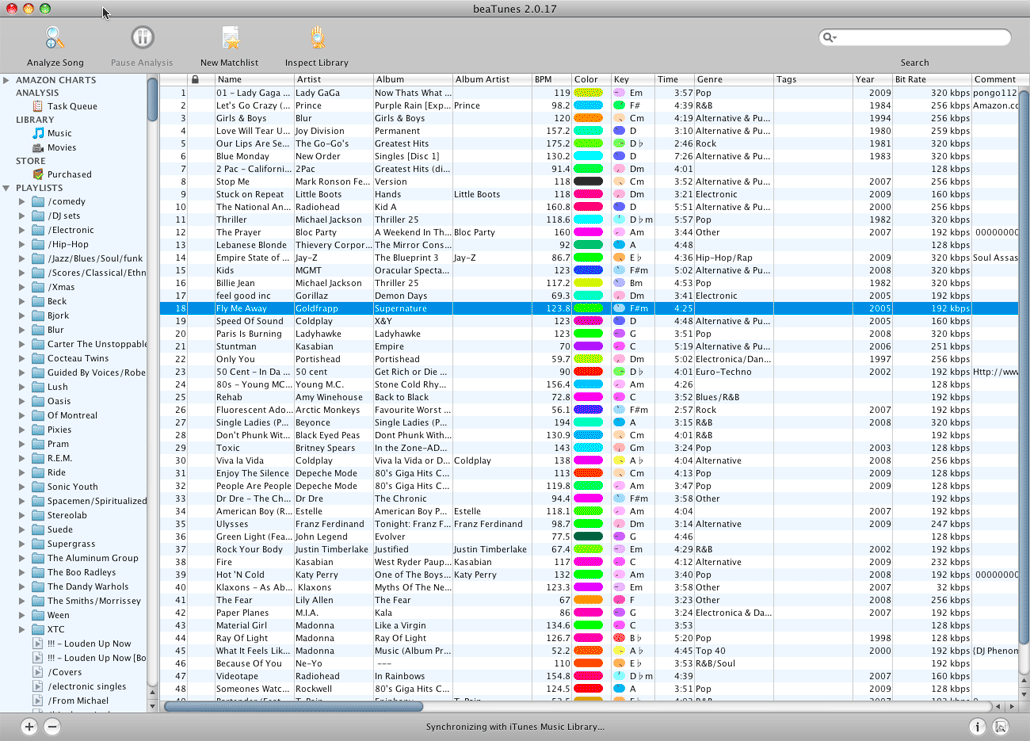
Beatunes2TAGTRAUM INDUSTRIES BEATUNES 2

Correct: 14 (28%)

Compatible: 18 (36%)

Incorrect: 18 (36%)

What else it does: BeaTunes 2 is an excellent complimentary program for iTunes. It helps you clean up your iTune Library by finding and correcting errors in the artist, album, title and other tags; searching for and adding other metadata such as album artwork, organizes songs with a color-coding system; determines BPM automatically or manually; and more. All of its changes are reflected in iTunes as well.

Price: $31.95 US for Mac or Windows
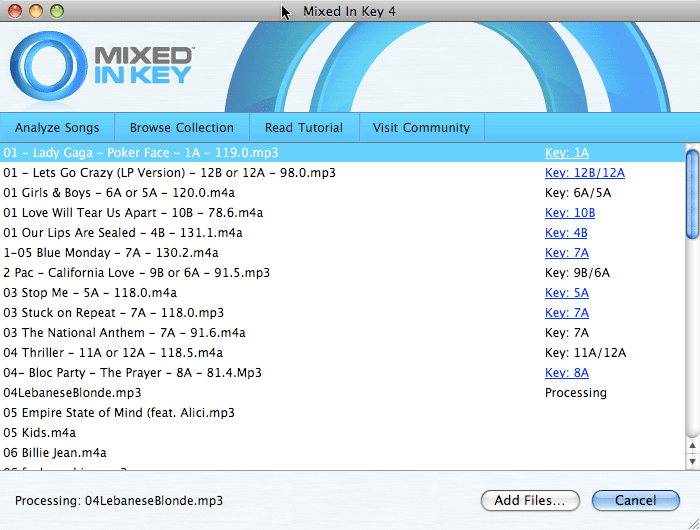
MIK4MIXED IN KEY 4

Correct: 15 (30%)

Compatible: 18 (36%)

Incorrect: 17 (34%)

What else it does: Not much besides tempo and key analysis. Its preference options for adding BPM/key to the file name, as well as different ID3 tags, are great.

Price: $58 US for Mac or Windows
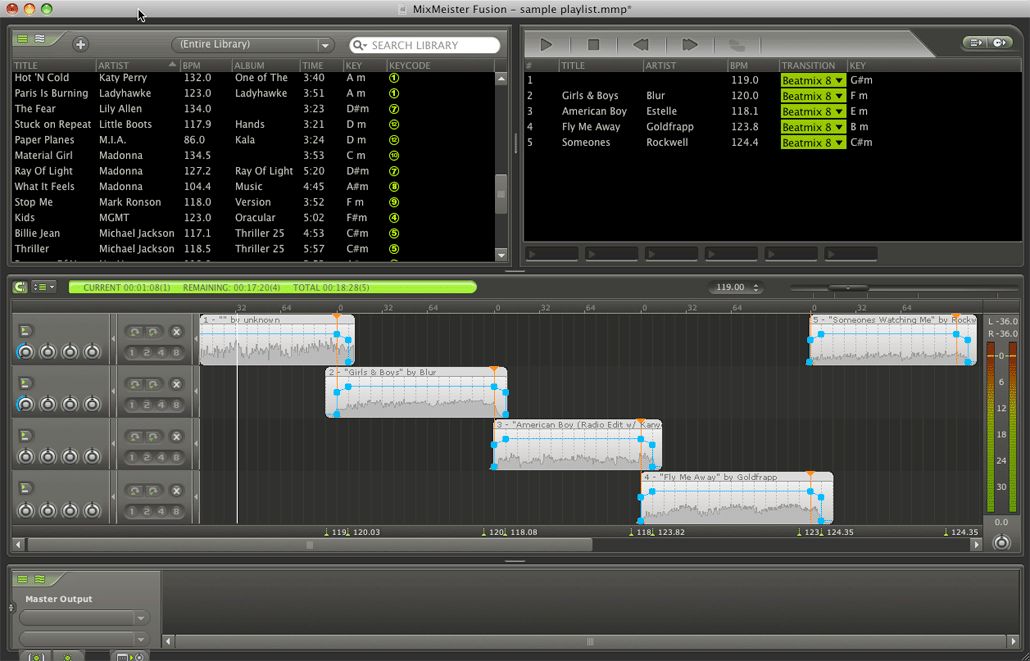
MixMeisterMIXMEISTER FUSION

Correct: 7 (14%)

Compatible: 14 (28%)

Incorrect: 29 (58%)

What else it does: MixMeister Fusion is a full-feautred, professional-level DJ software for creating and editing DJ mixes or DJing live with a digital audio workstation-style, timeline-based interface. A couple of the many notable features include mixing up to 8 tracks as once and support for VST effects.

Price: $329.95 for Mac or Windows (key detection also available in Mixmeister Studio for $199.95)
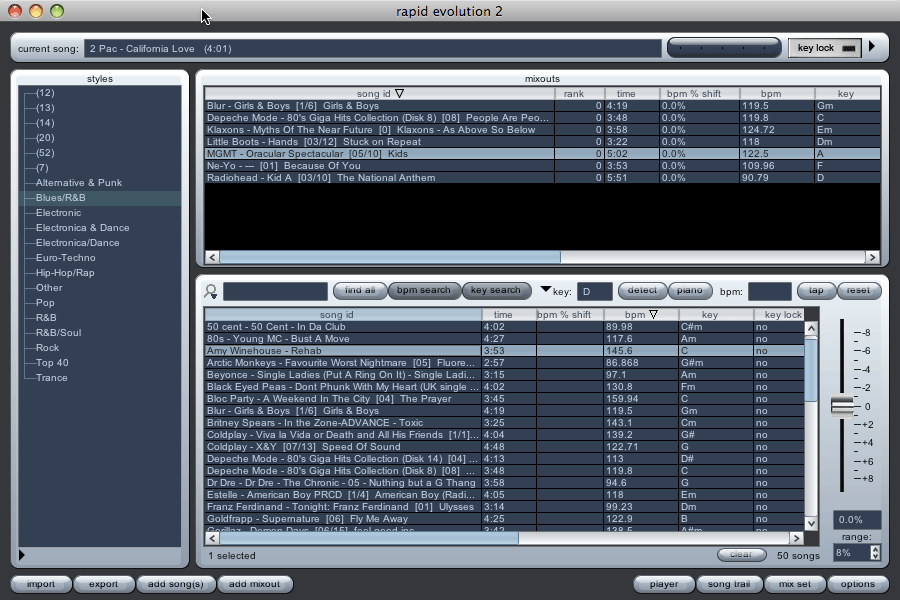
RE2MIXSHARE RAPID EVOLUTION 2

Correct: 15 (30%)

Compatible: 14 (28%)

Incorrect: 21 (42%)

What else it does: RE2 is an intelligently designed DJ utility made to use both and preparation for and during your sets. Besides tempo and key detection, it includes tap tempo and a software MIDI keyboard for you to work out BPM and key yourself, normalizing,time/pitch shift processing, live audio input analysis, key lock and more. You can save Mixouts, where you comment on mixes between particular songs. In addition, the MixShare website hosts a large harmonic mixing forum and a database of track information for hundreds of thousands of songs shared by RE2 users.

Price: Free for Mac or Windows (donations encouraged)

IMPERFECT HARMONY

It should be said that this test can only provide a look at the accuracy of each of these programs relative to each other, rather than an assessment of the overall accuracy. I was surprised at the number of incorrect readings for each program. I’ve seen some other similar tests with higher percentages for Correct and Compatible readings, so there may some particularly difficult songs in my test batch.

However, we can tell that that Mixed In Key 4 has the better numbers by a razor thin margin. MixMeister only gave out minor key results for some reason, which really hurt its stats.

Because Mixed In Key, BeaTunes and Rapid Evolution were statistically comparable, it comes down to which of those programs’ other features you want, as well as perhaps price.

My personal favorite is Mixed In Key, because it gives your results in the alpha-numeric Camelot System values — which is easier for mixing — processes files quickly and gives you some good options for how you want the key and BPM information to be added to the file name and to the file’s tags. However, it doesn’t do much more than key and BPM analysis, and it costs the most of the top-performing three.

As a free download, Rapid Evolution 2 gives you many interesting features besides key and tempo detection. and it makes up for not giving you the Camelot System numbers (User error: you CAN get the Camelot Sytem numbers in RE2 in the Keycode field.) You can look at only songs that are in a compatible key range, as well as similar in style and tempo.
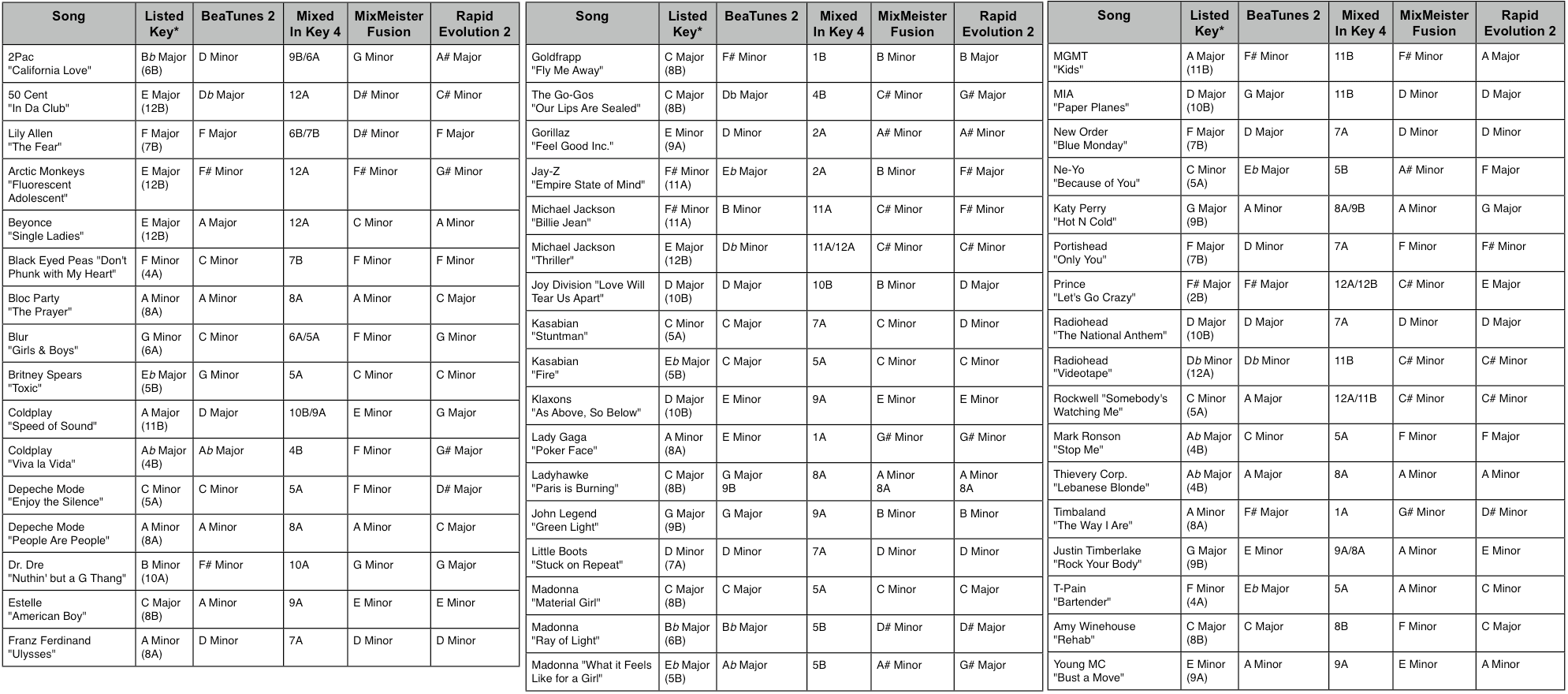
*Listed Key source: Musicnotes.com

*Listed Key source: Musicnotes.com

61 Responses to “Key Analysis Software Smackdown”

  1. weltraumpapst

    November 2nd, 2009 at 5:27 am Quote

    rapid evolution can do camelot numbers..
    options –> song –> use key codes instead of keys

  2. DjOntt

    November 2nd, 2009 at 5:36 am Quote

    You can assign key codes in RE 2 as well. To change the key format you need you go into options -> general and set the “key format” option to “key code”. After figuring this out i left MiK behind and switched to RE 2, since always i like to support open source software =)

  3. Vinicius Hoffmann [Brazil]

    November 2nd, 2009 at 5:41 am Quote

    nice post, I’m entering in harmonic mixing soon and I’m using RE2, since it’s free. Good to see that it has a good detection of the keys

  4. greatmesk

    November 2nd, 2009 at 5:42 am Quote

    Nice Comparision. Would be cool if VDJ would be in there too, as its also able to detect the camelot value and the Key.

  5. janzak

    November 2nd, 2009 at 6:00 am Quote

    I don’t know wtf I did wrong but the only time I used RE2, it deleted all files I analyzed and I ended up having to reassemble a big chunk of my music collection…

  6. BentoSan

    November 2nd, 2009 at 6:26 am Quote

    Sweet been hanging out for another smack down for a while now ! There was one a few years ago but i think its very fair to say that outdated now :)

    Nice work on the article Markkus !

  7. stump

    November 2nd, 2009 at 7:28 am Quote

    I have to say RE is hands down the worst program I’ve used on Mac. It is slow CPU hog and crashed occasionally. That said, the price is still unbeatable!

  8. Sheph

    November 2nd, 2009 at 7:35 am Quote

    Stability and ease of use should have been considered a feature! RE2 is cheap, but it’s flash based, buggy, and unstable.
    does it do the job for free though? yes.
    always backup anything important.

    S.

  9. f0tif0

    November 2nd, 2009 at 7:40 am Quote

    i use mix in key and it is amazing how this safes my time in picking out songs from my library for my gigs.
    Actually i USED to train myself to find songs that match each other by listening to them and it would take forever to go trough my 3000 House genre song collection. So during this Halloween I got Mix In Key it took the whole day to analyse my huge library. I did not even practice nor picked out songs that i am gonna play and went to the club.
    The first thing I notice when I started to play (holly shit) that thing work like a charm, Now I have so much control over the songs that i can switch them anytime I want without people even noticing it.
    So the whole Halloween party I played about 1:30 to 2:00 min of each song, so it was like house mash up.
    I was so impressed.
    I showed this to my mother who is a piano teacher and musician for over 30 years. She was stunned, and this was the first time she learned what was the camelot system and how it works.
    Mix In key is so good I cant describe it.
    Bigs up for Fella Russian who made this.

  10. DJSDive

    November 2nd, 2009 at 7:44 am Quote

    Note that the camelot wheel just makes the compatibility easily sortable. The original circle of fifths which has been around for quite some time has already privided a visual representation of key compatibility.

    In this light its great to hear that RE2 is not letting itself be scared off my legal FUD from MIK (or maybe they are not even aware of the licensing claims). I wrote up a detailed report about this:
    http://ifnotwhynot.me/mixed-in-key-not-playing-nice

    Some time has passed and when I last check the MIK licensing page it remained unchanged. I guess until they feel it in their pockets they will not consider correcting their licensing page to be less ambiguous.

    This licensing page is the reason why beaTunes does not provide support for the “camelot numbers” by default. I started but unfortunately never finished a plugin that would do the conversion right inside beaTunes.

  11. DJ ATP

    November 2nd, 2009 at 8:15 am Quote

    I can’t get RE 2 to actually write the values to the tags, like I told it to. I spent hours waiting for it to go through my whole list of tracks and find the keys, only to discover that it did not write them to the tags, and upon restart of RE 2, the values it had stored in its own database were also gone. WTF? Besides that, it took three or four tries to get it to actually analyze more than maybe ten songs without freezing or crashing. Buggy. As. Hell. Also, I don’t have the processor/RAM headroom to have RE2 open as well as Traktor, nor do I have a second computer or an external monitor to use for it either…so there’s no point in having a program designed to be open while I’m mixing if it’s not the program DOING the mixing. I am unimpressed.

    I’m trying out Mixed in Key right now, but I haven’t had a lot of time to mess with my DJ setup recently (been working on other projects). I’m hoping it will help me bump my mixes up a notch in the quality department. I missed out on a proper musical education when I was younger, so I struggle to learn music theory and stuff now, meaning tools like this would be a life saver. I’ve been practicing mixing for six years now, and I’m still no better than those kids who pick up a pair of Numark CD decks and begin rocking parties from day one. I must be missing something. Here’s hoping Mixed in Key will help me find what I’m missing and catch up.

  12. Adam G

    November 2nd, 2009 at 8:29 am Quote

    Great post but as already mentioned it was a gross oversight to mention RE2 without discussing software performance. (Plus realising it Does do Camelot Key’s before rating a software… sorry but you really should know exactly what you are talking about if you are going to review something.)

    As a user of Rapid Evolution for over 4 years I can say it did me a world of good when I was starting out. Least of all because it was FREE.

    However, as someone who is still in the game it is time to take things more seriously; RE2’s lack of stability, CPU inefficiency and random glitches pushed me to purchase Mixed In Key 4 just last week (coincidentally). I can safely say so far no crashes, considerably Less CPU usage, and satisfactorily quick: 1 minute (+-20 sec) (tops) per track.

    MIK 4 does however need more features, and for a software that has such (wanky) HIGH praise from the likes of Pete Tong, Hernan Cattaneo, Dubfire etc etc, it REALLY needs to up its game… I mean COME on there are many more features it could (relatively easily I would think) implement to make it worthy of its premium price tag.

    That my two cents, hope I didnt just spit verbatim whats already been said.
    Cheers
    Adam

  13. Dj Abe

    November 2nd, 2009 at 8:57 am Quote

    Ge

  14. Dj Abe

    November 2nd, 2009 at 8:58 am Quote

    Another gear or review post. Ugh!

  15. Priscilla

    November 2nd, 2009 at 8:59 am Quote

    Wow Mixed in key got that many songs incorrect. Interesting.

  16. JesC

    November 2nd, 2009 at 9:45 am Quote

    nice write up markkus! Gonna take the plunge and get MIK. I need to start mixing my tracks in key to improve the sound of my sets. Gracias Señor!

  17. Dj Nvidia

    November 2nd, 2009 at 10:15 am Quote

    Yea, I use Mix In Key 4 (MIK 4), it works pretty well… and Its pretty quick too… but when I was looking for an alternative to it (before I decided to buy it), I definitely looked at RE2, but it just didn’t work as easy, quick and understandable as MIK 4.

  18. weasel

    November 2nd, 2009 at 11:14 am Quote

    RE: the high amount of incorrect values,
    did you actually check the keys from the shete music page? cause i know from experience that a lot of the sheet music pages are off, or at least shifted by 1-2 semitones.

    since on a couple of songs in your table, all programs seem to detect the same “wrong” value, it might be that the ke provided in the sheet is different from the actual mp3 you used.

    just saying…

  19. Pepehouse

    November 2nd, 2009 at 11:26 am Quote

    This test shows what I was afraid of: The sellers promise key detection heaven and the software really doesn’t work properly most of the time, is like with keylock, the algorithms are far from perfect and it’s better to don’t use it. Good job, it has confirmed my suspicions.

  20. Mello

    November 2nd, 2009 at 1:32 pm Quote

    I can’t get RE 2 to actually write the values to the tags, like I told it to. I spent hours waiting for it to go through my whole list of tracks and find the keys, only to discover that it did not write them to the tags, and upon restart of RE 2, the values it had stored in its own database were also gone. WTF? Besides that, it took three or four tries to get it to actually analyze more than maybe ten songs without freezing or crashing. Buggy. As. Hell.

    Same here it´s just too buggy and unstable

  21. Mark Davis

    November 2nd, 2009 at 1:43 pm Quote

    Excellent article! Thanks for your comparison. Your results are similar to those produced by our software comparison back in 2006 (see http://www.mixingonbeat.com/phpbb/viewtopic.php?t=2268).

    Mixmeister’s relatively poor performance in this test is probably due to the comparatively large share of pop/rock songs in your test group, because more pop/rock songs are in major keys compared to dance music since the 1980s. Mixmeister’s accuracy would probably improve if comparisons were limited to dance music.

    It is unlikely, however that key detection software will ever gain the accuracy of a highly skilled musician in detecting keys, because human judgment is best for locating the tonal center of any track, and therefore best for identifying its key.

    For example, “Sexyback” is usually miskeyed by software as a B-Flat Minor (3A), while the true tonal center is a half-step lower at A-Minor (8A). A human can “feel” the center while a computer can only estimate. This is why we encourage DJ’s to use software for “quick and dirty” key detection, and then refer to our 56,000+ record database of musician-keyed music for greater accuracy as tracks are keyed by professional musician.

    Working with MIK, we have finally placed our entire database online at camelotsound.com. Some filters are already in place, including speed range, style, artist, title, and keycodes of individual tracks. Future filters will include keycode range and age of track.

    We have already input nineteen >100-key updates for 2009, although we only guarantee one per month. Some new releases will never be keyed, and others will always involve lead time between release and inclusion in the database.

  22. DJ Andre

    November 2nd, 2009 at 3:04 pm Quote

    Nice work! It was a good thing to have a current product comparison.

  23. midifidler

    November 2nd, 2009 at 4:14 pm Quote

    This test shows what I was afraid of: The sellers promise key detection heaven and the software really doesn’t work properly most of the time, is like with keylock, the algorithms are far from perfect and it’s better to don’t use it. Good job, it has confirmed my suspicions.

    I think you are missing the point of using this kind of digital aid, it is not supposed to replace you ears or aural memory of your crates, it is just a guide…

    Do you actually also apply this logic to your use of key-lock ?

  24. Anonymous

    November 2nd, 2009 at 11:12 pm Quote

    I have one kiiiiind-of related question regarding mixing in key with Traktor.

    In the newest version of Traktor, the (+)/(-) buttons on the KEY knob now adjust in increments of 2.0 instead 0.5 like its used to. This is extremely annoying to me because I often change the keys of songs, and having an easy button to adjust semi-tones and (when the track is a bit off) half-tones was very useful indeed.

    Is there any way to adjust the increments of the (+)/(-) buttons?

  25. Jay

    November 2nd, 2009 at 11:13 pm Quote

    I have one kiiiiind-of related question regarding mixing in key with Traktor.

    In the newest version of Traktor, the (+)/(-) buttons on the KEY knob now adjust in increments of 2.0 instead 0.5 like its used to. This is extremely annoying to me because I often change the keys of songs, and having an easy button to adjust semi-tones and (when the track is a bit off) half-tones was very useful indeed.

    Is there any way to adjust the increments of the (+)/(-) buttons?

  26. DJ Anthony Jacobs

    November 2nd, 2009 at 11:18 pm Quote

    Due to the high percentage of inconsistencies in all these programs, using this software as a guide almost seems to be waste of time, as you’d have to double check each key result against your own ability to find the key anyway…

    I religiously key all of my tracks using a piano or guitar as I’m importing music into my iTunes collection. I then enter the key information in my iTunes “Comments” tab. Then I import those files into Traktor and now add the Key Code number in Traktor’s “Key” field. This allows me to sort via these 2 columns in Traktor’s browser and search through all compatible keys both alphabetically AND/OR numerically. ;o)

  27. empolo

    November 2nd, 2009 at 11:35 pm Quote

    Gotta register my “huh??” regarding the incorrect info about RE and Camelot key numbering – that deserves a correction in the article as an update.

    It *is* somewhat slow and can be a bit unruly. I’ve get the best performance by only analyzing around 15-20 songs at a time – no crashes with that method. Not the most efficient but the increased stability is worth it.

  28. Pieter

    November 3rd, 2009 at 1:55 am Quote

    I do want to say something about RE2 and saving the camelots or keys to the tags, it actually is possible, and this manner even makes my library ‘better’ than if you’d just write those tags:
    After analyzing the tracks, you select all tracks and choose to rewrite the name tags, to the string artist – song – release- genre – key or something like that, if there is no genre you just get an empty space for example
    Then you use tag& rename or a similar program to rewrite all your tags according to the name tag, if you want to write to the comments field, be sure to delete all id tags first, or it will just put the key After your first comment.
    Then your unneccesary tags will be gone and your name tags are built up on a uniform way, so you can always recover your tags when needed and browse with the file names
    Sometimes a’ -’ will be in your tag, then you have to do it manually or use other, less used symbols in your name tags to separate them

  29. gfocus

    November 3rd, 2009 at 4:39 am Quote

    I’m a happy RE2 user. I do have problems keying mp3s with embedded album art work from time to time. My process now includes extracting the image files before analysis. It’s free, it’s fast and not lesser accurate than commercial solutions. Oh and it’s written in Java, not in flash like one commenter noted.

    This review just confirms that no key analysis software can fully substitute for knowing your library and trusting your gut feel when mixing.

  30. Johnny Vulcan

    November 3rd, 2009 at 4:54 am Quote

    I’ve been considering these tools for a while, but as posted above, it almost seems a waste to have to double check everything with a keyboard. Why don’t more of us cue the track, listen for a sec, and just tune the track via key adjustments on our controllers? That’s my workflow, amd it works well. If it’s too far out of key, I won’t use the track. The other thing I’m worried about if I try this is possibly NOT picking tracks based on a key value. We have key adjust in our software so that we can flex things when needed. Just a thought.

  31. Anonymous

    November 3rd, 2009 at 6:03 am Quote

    I have one kiiiiind-of related question regarding mixing in key with Traktor.

    In the newest version of Traktor, the (+)/(-) buttons on the KEY knob now adjust in increments of 2.0 instead 0.5 like its used to. This is extremely annoying to me because I often change the keys of songs, and having an easy button to adjust semi-tones and (when the track is a bit off) half-tones was very useful indeed.

    Is there any way to adjust the increments of the (+)/(-) buttons?

    Hi Jay,

    I had the same prob. Then I found out that if you right-click on the key button you can set the icrements of the +-. Try it!

    cheers

  32. Andrew Ford

    November 3rd, 2009 at 11:17 am Quote

    I find the software MIDI piano to be one of RE2’s best features. It allows you to automatically play a minor/major chord with only 1 key press on a standard alphanumeric computer keyboard, thus allowing you to play chords easily without a real piano or midi keyboard.

    I’ve always keyed my tracks first by analyzing with MIK, writing the key in the comments, then analyzing tracks in RE2. If the results differ, I use RE2’s piano to find the correct key. It doesn’t take much extra time but you get more accurate results.

  33. That guy

    November 3rd, 2009 at 11:20 am Quote

    I think using your ears is the best program out there. part of the skills a dj must have is knowledge and recollection of music. a dj without that is like a doctor that doesnt know anatomy.

  34. Markku Uttula

    November 4th, 2009 at 8:21 am Quote

    part of the skills a dj must have is knowledge and recollection of music. a dj without that is like a doctor that doesnt know anatomy.

    Knowing something and being handicapped in the area of knowledge are two different things. Many people are more or less “tone-deaf” (in the manner that they can not distinquish C from D unless given a comparison point – and even at that point they still fail).

    Perhaps a more closer simile would be an opthamologist with colour-vision impairment … still very capable of doing the job, but needs help on some areas.

  35. Yakov (Mixed In Key)

    November 4th, 2009 at 11:29 am Quote

    Hey all,

    Markkus, thanks for a very interesting comparison and a good article. Just wanted to say we appreciate it.

    -Yakov

  36. qualia

    November 4th, 2009 at 4:14 pm Quote

    thanks markkus for putting together this article!

    i don’t suppose there is any way of getting the files you used to test? i’d like to try to verify the results. in particular, RE2 has several tweakable options which could affect the accuracy (such as the detection of advanced keys, and start/end keys differently, and the accuracy/speed slider option) and i’m curious if that would have an effect on the results. plus, as mentioned in another post here it would allow us to verify the results from musicnotes.com in case the values you’re using to compare are off

    as mentioned previously, re2 does support key codes, and in fact has devised an expanded key code system to account for various modalities/advanced keys.

    i agree with a lot of the common problems people have been having with re2 (not easy to use, buggy, cpu hog, etc). in fact, i’ve been busy working on re3 which addresses all of these issues (brand new native GUI, less memory and CPU usage), not to mention, it will blow the functionality of re2 away! hopefully i’ll have re3 ready before round 2 :-)

  37. markkus

    November 4th, 2009 at 5:47 pm Quote

    Qualia: Sorry for the error on key codes. For the record, I did have the Accuracy slider cranked all the way up for the highest accuracy.

    I know there are new versions in the works of all three of the top-performing programs here, so I smell a part 2 to this article sometime in the future. A follow-up article will include a test batch of tracks that are all in the same key, to see if the variances in key detection remain consistent from song to song.

  38. Turntable Terrorist

    November 5th, 2009 at 3:09 am Quote

    Hi and thanks for that nice overview of whats out there.
    I tested RE2 read and then write the Keys. Now my thing is :
    How to set the up right for Traktor Pro ? When the Keys where written, they dont show up in the Key section of Traktor Pro. Just in the song name like 10a – Songname.mp3. Is there a way to make that going for Traktor Pro so it shows up only in Key sectionor is this work i have to do by myself ?

  39. Matt Hite

    November 5th, 2009 at 3:39 pm Quote

    I wouldn’t count on musicnotes.com as your control group. It’s just not dependable. Why not post the track names so we can verify the keys manually?

    Thanks!

  40. markkus

    November 5th, 2009 at 4:15 pm Quote

    I wouldn’t count on musicnotes.com as your control group. It’s just not dependable. Why not post the track names so we can verify the keys manually?
    Thanks!

    Hey Matt:
    All the track names are in the chart at the bottom. Click on it to have it blow up to a readable size.
    Thanks.

  41. Matt Hite

    November 5th, 2009 at 6:18 pm Quote

    Markkus:

    Yikes! I didn’t see that. Thanks.

  42. jeremy i

    November 5th, 2009 at 7:59 pm Quote

    learn to do it yourself using a keyboard/piano

    without knowing even so much as the keys that are in a chord, i came up with a simple system and it took me a few months of doing all my songs manually (slowly and consulting charts and the mixing wheel) and now I can key a song in 5 seconds (which is faster than the software)

    i literally hit play, buzz to the middle of the track where theres lots of musical elements and 5 to 10 seconds later i can alt-tab and rename the mp3 with the keycode.

  43. Ally

    November 6th, 2009 at 2:51 am Quote

    Stills stuns me with the lack of accuracy of Mixed in key, and how far it is off,

    I will do a follow up test guys in a week or so……..with a large batch of Samples(Basslines/Arpeggios/Chord progresssions, etc both in Major and Minor Key, and both with Drums and without drums, as I feel these bloody programs really NEED FOUND OUT, AND THEIR ACCURACY IN THE REAL WORLD IS APPALLING TO SAY THE LEAST! at least for the “Premium” programs.

    If anyones interested our company is just finishing off the cirriculum for a definitive and complete “Music Theory for Djs” course starting ear;ly next year…….i’ll keep you all updated.

  44. Tucci

    November 8th, 2009 at 6:57 am Quote

    this makes me real glad i know music theory. busting out a guitar for ten minutes a week leaves me with about 90% correct and 10% compatible. that color wheel must be pretty useful if you don’t know anything about intervals. i wonder if anyone uses it in the booth :)

  45. Ed

    November 10th, 2009 at 12:39 pm Quote

    I was thinking about buying Mixed in Key 4 but frankly I have my doubts now- there apparently is a better, free key detector out there but the name escapes me at the moment:(.

  46. 45rpm

    November 12th, 2009 at 10:25 pm Quote

    markkus, I appreciate the hard work you did, but many of the songs are not in the key you think they’re in. Here are some examples:

    Our Lips are Sealed is not in C. It’s in Ab.
    Lebanese Blonde is not in Ab. It’s in A minor.
    Somebody’s Watching Me is not in C minor. It’s in C# minor.
    Thriller is not in E. It’s in C# minor.
    California Love is not in Bb. It’s in G minor.

    Matt is correct that you are not getting the true keys in a reliable manner.

  47. MG

    November 15th, 2009 at 9:39 am Quote

    Mixed in Key is phenomenal. It has helped me train my ears to which keys are compatible, and my transitions are so smooth compared to what they were before.

    The 4.0 upgrade is a must, as I’ve had earlier versions of Mixed in Key that wouldn’t calculate the key correctly.

    I highly recommend this program to any DJ who’s having trouble with harmonic mixing. You won’t be disappointed.

  48. deepstereo

    November 20th, 2009 at 4:03 am Quote

    That’s a great article! I’ve tried RE2 for a while on a Vista PC and honestly I had a number of troubles with it. First, it just refused to write the Key information to tags, so I had to manually enter it in the comments field in iTunes. And for me it didn’t really read the playlists from iTunes and it wasn’t an easy task to select a playlist and analyse it.

    There aren’t many replies about BeaTunes though and I decided to give it a try. I like the fact that it integrates with iTunes perfectly.

  49. DJSDive

    November 21st, 2009 at 1:04 pm Quote

    I was pondering your review and that got me wondering if there is another criteria that might be worth applying as well is if the key detection is consistently off in the same direction. As in are 5A’s consistently detected as 6A’s if the detection is off .. or 7A .. obviously the results would be much worse if its sometimes 4A and sometimes 6A. In a way this would be another class of matches that is slightly different in concept than the “compatible” class you already used in the review.

  50. deepstereo

    November 23rd, 2009 at 4:11 am Quote

    Just to update, I used a trial version of BeaTunes last weekend and I must say I was pretty happy with it. Because it works nicely with iTunes and the key detection was really fast, compared to RE2.
    I’m really considering buying it now, it’s just $31. Twice cheaper than MiK, although I haven’t tried the latter.

  51. liquidray

    December 28th, 2009 at 12:30 pm Quote

    markkus, I appreciate the hard work you did, but many of the songs are not in the key you think they’re in. Here are some examples:

    Our Lips are Sealed is not in C. It’s in Ab.
    Lebanese Blonde is not in Ab. It’s in A minor.
    Somebody’s Watching Me is not in C minor. It’s in C# minor.
    Thriller is not in E. It’s in C# minor.
    California Love is not in Bb. It’s in G minor.

    Matt is correct that you are not getting the true keys in a reliable manner.

    WOW based on that the MixMeiser seems to hit the spot on pretty well!

    BTW is there a good primer to help determine manually what the key is? I dont have any music theory under my belt so I would love some help learning it the old skool way

    Great article btw! I am looking to pick up both MM & MIK after this!

  52. Jonsafer

    January 2nd, 2010 at 5:22 am Quote

    This test shows what I was afraid of: The sellers promise key detection heaven and the software really doesn’t work properly most of the time, is like with keylock, the algorithms are far from perfect and it’s better to don’t use it. Good job, it has confirmed my suspicions.

    x

  53. Hard Lee

    January 3rd, 2010 at 6:26 am Quote

    dissonance is subjective

    I have been using beatunes .. as much as I struggle with itunes it works better than most things on osx for sorting music (that I have found)

    So (key accuracy aside) I enjoy being able to sift through tunes in itunes, then the ability to harmonically sort the playlist with beatunes and then to pick the playlist up ‘in order’ inside Serato.

    So far I have really enjoyed the results with beatunes. It works for my situation.

  54. jerry

    January 5th, 2010 at 1:05 am Quote

    Mixed in key and the likes, LMAO!!! Next thing is ones ‘pet monkey’ mixing and djing for you whilst you’re at home watching tv. I love technology like a crackhead to crack, but when it starts to take the musicianship from djing i have a problem with that.

  55. Jonsafer

    January 6th, 2010 at 4:19 am Quote

    I have noticed that Mixed In Key team invests a lot of resources into quick replying, marketing like “this known DJ uses our software” and researching of hot water with “The Secret DJ Technique: How To Create the Perfect DJ Mix”.

    Sorry guys but until software works good enough all this is 1/5.

  56. Mark Davis

    January 8th, 2010 at 1:40 pm Quote

    Jerry: How does key detection software “take the musicianship from djing”? Most American youth have very limited music education since schools started dropping “Art” courses due to budget cuts in the 1980’s.

  57. Jeremy Espinosa

    January 29th, 2010 at 4:34 pm Quote

    I read every single comment on this article and wanted to give my 2 cents. It is obvious that detection software, without having all the individual elements of a mixed track, will never be perfect. The new version of Melodyne has the same problem with its new Direct Note Access feature for editing polyphonic notes. Some songs will always detect better than others. Melodyne is a $300 program.

    Having said that, I’m a Mixed in Key user since version 1. I have been very satisfied especially since I am entitled to lifetime updates. I’m very glad I spent the money and even if I didn’t receive the free updates I would pay to upgrade each version.

    I think those that have their own system of accurately keying their tracks are lucky and don’t need this product. But for those of us that are not musically trained and were good DJs before they found this product, this will only take your mixing to the next level.

    I found that mixing two House tracks out of key does not always sound bad. I will occasionally jump around the Camelot wheel just because I think a certain track will be a real crowd pleaser at that time. But having a program like this will immediately increase the possibilities of longer blends and some really amazing mixes. I still on occasion will change my mind on a track because when cueing in my headphones it does not sound good. But this happens a whole lot less than before I was using Mixed in Key.

  58. Jonsafer

    February 2nd, 2010 at 12:07 pm Quote

    Jeremy Espinosa:

    It is obvious that detection software, without having all the individual elements of a mixed track, will never be perfect. The new version of Melodyne has the same problem with its new Direct Note Access feature for editing polyphonic notes. Some songs will always detect better than others. Melodyne is a $300 program.

    Mixed in key is a $58 program. Rapid Evolution is a 0$ program.

    They both do the same thing with the same results.

    Eh?

Leave a Reply

  1. Quote selected text

First Time?

This site is dedicated to digital djs. We develop performance tools and teach cutting edge techniques that enable creative expression. Visit tutorial videos on youtube, equipment reviews in the blog and a very helpful community in the forum. New articles every Mon, Wed, Fri.
In the Store
 

Categories:
Follow us:
You're going to need Flash 8+ and JavaScript to use this site. How'd you get this far without it?

Dig through the Crates

Readers are Saying

  • ManDingo: ManDingo wants to know when the MidiFighters with the joystick will be availabe. please let him know so that he may...
  • RCUS: @dj broken record: I am almost 100% sure DJTT wouldn’t limit it to a Traktor only contest so don’t let that...
  • dj broken record: a question – is traktor the required software? what about torq?
  • Vince: you should do more contests like this more often with different prizes
  • kilbot: nice video and the contest is great idea! however I have to agree with others, in that regardless of how subjective...