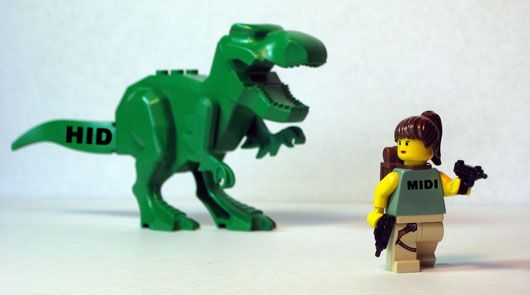
HID- The beginning of the end.

We are living during a relatively new and exciting time in digital djing when everyone is free to use and re-configure almost any controller with any software. Enjoy it, because the market might not be like this for long. Software and Hardware companies are realizing that they need to team up and create integrated packages that work really well out of the box. Itch and the VCI-300 was the first good example of this in action. Together, that dynamic duo works very well but for anyone that wants to re-configure Itch or use the 300 with other software will run into problems. Even though the 300 is now fully supported in Traktor, its nearly impossible to get the same level of performance and integration out of MIDI that the original manufacturer achieved with HID.
Is midi so bad?
No its not, MIDI is just 20 years old and stretched to the limits of its capacity. You can only get so much performance out of 127 messages and its very hard to program really complex interactions. Instead, manufactures will turn to HID which provides a much better way of connecting hardware and software in a proprietary way. Because HID lives at a very low level and requires no drivers, it tends to be faster, more reliable and have lower latency. It also allows a hardware designer to make dj gear do whatever they need without the restrictions of an ancient standard.
While this is certainly going to produce better controllers and happier customers, it will come at a price. In the future, your controller will come paired with a piece of software and the “options” of what you (and we) can do to re-imagine the possibilities will be limited.
This future may even put many of the mid sized controller outfits out of business. There will be no way their controller, which is restricted to functions the midi spec supports, can ever compete with HID and full software integration. The 300, which offers the best scratch performance available on a controller is a great example and simply would not have been possible with MIDI.
The Bottom line
This type of environment puts a lot of influence and power in the hands of the software companies. If the number of big players in that realm stays small then they will have the luxury of handpicking who they choose to work with or eventually just make their own controllers for the sake of performance. Hardware only companies like Vestax will have 2 options:
1) make their own software (and try to catch up) or team up with a software company
2) Develop exclusive types of hardware control and use it as leverage against the software boys.
In many ways this new dj technology must follow that path of others before it. There was once a day when a car was a very simple thing and the really adventourous or motivated could take them apart and re-build everything to suit. Eventually modification and easy customization will give way to the demand of convienence and features. Personally I am torn between these 2 worlds. On one hand its obvious that dj controllers need to improve if they will ever take over the role of a turntable. Then again, it will be very sad to see the great DIY, create your own dj adventure ride that we have been on end. Perhaps it wont end there, and just take another twist down a new road to a destination yet unkown.


April 22nd, 2009 at 9:29 pm Quote
sorry man, but OSC is what the future of controller protocols is all about, HID will be a step in between at most I think.
April 22nd, 2009 at 9:38 pm Quote
I bealive that using HID or any modern protocol will bring controllers to this new era when a flexible protocol is very useful. Maybe this will enable also more conectivity technologies in between controllers ex: a series of bluetooth VCI´s combining into a single channel, and also in between controllers and pcs.
April 22nd, 2009 at 9:47 pm Quote
OSC definately seems like it will be a major step. Especially due to the restrictions seen with HID. I think its possible both will exist simultaniously but for different purposes. OSC replacing MIDI and HID for direct Hardware/Software linked stuff.
April 22nd, 2009 at 10:26 pm Quote
Midi will do just fine, when needed (let’s say for example an pitch fader) 14bit midi can be used to get an high resolution. The only thing is that you can use a maximum of sixteen 14bit midi messages but for 99% of the dj’s that will be more than enough.
The Vestax VCI-300 also sends 14bit midi messages but it does it at another way than an S1200 from Denon does.
There are 2 way’s to send 14bit midi data
1 – The easy way that is supported by all software manufacturers and that is using the pitch bend method.
2 – The other way is sendig 2 messages simultainiously and the software devides message one by message 2.
In both casses you have 16384 steps and that is more than enough for an pitch fader which for example gives you an pitch resolution 0,0001% at an 20% pitch range…
And you only need the 14bit midi data for an pitch fader, rotating jogwheel etcetera. For an button an on/off message works just fine… i don’t see why that should be OSC or HID.
Just stick to the standard midi messages… it will do it’s job just fine.
—> Pardon my french, i’m dutch ;-)
April 22nd, 2009 at 10:29 pm Quote
Must be an 10% pitch range, my bad…
April 22nd, 2009 at 10:35 pm Quote
Jeezzzzz i should do this in one post but i saw an mistake in Ean’s text.
The VCI-300 does end regular midi data (link is image to output data of the VCI-300), http://www.aboutdj.nl/images/stories/reviews/vestax_vci300_12.jpg
It does it as i descibed in my earlier post, sending 2 messages simultainiously and the software devides message one by message two with the same result as an pitch bend message and that is 16384 steps from begin to end.
April 22nd, 2009 at 11:31 pm Quote
Sorry cannot agree with much of this post – as others have stated, OSC is the future, and is very flexible and open. There is no excuse for new hardware and software not to adopt it.
Further to that the hacking-MIDI approach seems to be at least a workable practical solution, there are always more MIDI channels you can use.
AND HID is not necessarily a proprietary lock-in either. In fact, if it is “no drivers” HID (e.g. joystick or other generic HID etc as opposed to custom HID) then supporting custom/user mapping (in the same manner as MIDI) is entirely possible.
So please, lighten up on the doom and gloom! We need to let manufacturers know that we want devices that have a well defined command output (and input for lights/meters) etc set, and whether this is MIDI, generic HID or OSC there will always be ways of getting it into your favourite app via a mapping layer! The future looks bright!
April 22nd, 2009 at 11:37 pm Quote
Just to make an example, the problem with the VCI-100 (which I have and love btw) is what?
Answer: That it has some buttons that don’t return midi but instead change some arbitrary state on the device. All the features that are implemented on the device (e.g. the vinyl mode switching, the effect select button changing the commands sent by the effects section) could be very simply implemented in a software layer.
So the lesson for Vestax: make a controller which outputs values for every knob/button on the device, and document the values. If, to improve the experience with particular software, hardware “modes” are needed, ensure they can be switched off (with a boot mode, or a switch on the back of the device). AND document the limitations/special modes in the marketing material/manual!
sorry.. rant over…
April 23rd, 2009 at 12:07 am Quote
Hey guys the great positive is that there are passionate people like us here, who not only challenge the present day, but who also look to the future with anticipation…
April 23rd, 2009 at 12:09 am Quote
Sorry guys, bottom paragraph from…
April 23rd, 2009 at 12:16 am Quote
Im not a software guy but I think directly comparing OSC with HID is incorrect.
OSC is purely a protocol, HID is a driver device class.
OSC will still need some extra driver to translate from the physical connection medium like for example … USB HID
April 23rd, 2009 at 1:54 am Quote
Midifidler is right, it’s not an either-or scenario. HID and MIDI can live quite easily side by side, and I don’t think that is clearly stated in this article. Choosing an HID device doesn’t necessarily mean that it won’t be configurable.
What Ean’s real point (I think) here is that developers are starting to take sides as to whether they opt for super tight integration in a closed system, or possibly not as tight integration using an open standard. Devices like the VCI-300 and NS7 are closed systems bundled with Itch. Systems like the VCI-100 and ALL of Stanton’s MIDI controllers are open and allow users to combine them with a myriad of software. Right now I don’t think either camp gets it 100% right.
I totally understand the desire to lock the user out of the configuration and totally control both the hardware and software. It means you can have tight integration without needing to worry about adhering to a standard. And right now, without a real standard that is capable of performing at the level we are beginning to need, it’s just easier to send raw data. No message size limits – no message per millisecond bandwidth limitations. But I also think that customers want the ability to choose, and want to know that they’ll get use out of their hardware no matter what software they decide to use. And that means open standards.
I’m not going to turn this into a pro-Stanton stroke session, but I think that it’s possible for us to have a happy medium. When I look at what’s possible with middleware, it makes me think that at least some form of this solution is the future. As developers, we no longer really worry about things like HD-MIDI, because it’s trivial for us to implement it (or any other protocol that happens to come into favor) without any real hardware revision. We don’t care if Serato puts out their 1.9 software and adds a bunch of new stuff, or NI moves from 3.4 to Traktor Pro. We don’t care if your application supports MIDI feedback or not, because if it doesn’t we can generate our own using the logic engine in the middleware.
Programs like MIDI Translator are the future of MIDI devices. They will allow us to utilize the hardware we want, handling communication and traslation without needing developer support. And they will allow us to give that hardware functionality it doesn’t normally have, because we’re leveraging the power of the host computer and running a logic engine that can be programmed to work the way we see fit.
April 23rd, 2009 at 2:38 am Quote
nem0nic – exactly. Agree 100%. Thanks for explaining it way more clearly than I could…
April 23rd, 2009 at 3:38 am Quote
Yeah I gotta say Stanton most def has the right idea on how to implement things. The hardware has to be a stupid as possible, its only role should be in accuratley communicating changes in interface state at an individual level
April 23rd, 2009 at 4:11 am Quote
Excuse my ignorance, but what does HID and OSC stand for? Can you give an example of what, if any, technology already uses it?
How does they differ from the signals sent via MIDI? Is it more channels, signals, wider bandwith, less latency?
I’ve been out of the loop for a while.
Thanks!
April 23rd, 2009 at 5:18 am Quote
HID is human interface device, like a mouse or keyboard
as for OSC… http://en.wikipedia.org/wiki/OpenSound_Control
hope i helped a bit
April 23rd, 2009 at 5:59 am Quote
Thanks Izzy,
It clears it up.
Technically, does the VCI 100 count as both an HID and a midi device?
April 23rd, 2009 at 6:49 am Quote
What does HID and OSC actually stand for?
April 23rd, 2009 at 7:52 am Quote
no one is mentioning the for years under development standard midi-hd…. why ???
http://en.wikipedia.org/wiki/Musical_Instrument_Digital_Interface#Beyond_MIDI_1.0
April 23rd, 2009 at 9:01 am Quote
Manufacturers love MIDI because stuffing it in IC does not require large RAM or PARSING code. On the other hand, OSC does need both since it is based on string paths (not byte) and has greater precision and versatility (different data types).
Next logical step is different for each and every part of the industry.
I would say that OSC taking over MIDI is nice but it is more likely to take over DMX.
With HID, everything would be nice if someone would just STANDARDISE some communication basics. This way, if each and every manufacturer starts creating its own standard and own crappy dj-software we are back to the stone age. Ok, a bit exaggerated, I know.
Nemonic is right with that software layering. That will surely be the case if manufacturers start going each to its own direction. That will open new space for rewerse engeneers and universal translator that will have plugin system. For each device you create a plugin in order to communicate it. Someting like winamp, an empty shell with: input,output,dsp and gen purpose plugins.
April 23rd, 2009 at 10:09 am Quote
…
Missed shot…
http://www.create.ucsb.edu/~dano/CUI/
MIDI (14 bits sysex with 18F4553).
HID.
OSC.
OPEN SOURCE.
FULL Programable.
Maybe Serato will open ITCH or maybe us will left Serato alone…
Who knows? Who cares?
Pure Data is the next step.
…
April 23rd, 2009 at 12:01 pm Quote
Nemonic does a great job (possibly better than me) of explaining the “implied” point of this article. This is not about HID verses MIDI, they will continue to live side by side. The point is that unless a HID standard is released, or the midi HD standard is adopted- then companies will instead go down the easy road of building devices on HID which is the easiest way right now to have a tight integration of hardware and software.
This is will come at the cost of the mod world because we cant reconfigure those combination’s as there is no standard or interface to do so. It seems a 2nd follow up article is in order, that explains these finer details and the terms themselves.
OSC is a good point and will probably be more popular in the future. It may even replace MIDI but that wont do anyone any good, if everything is built on HID in the first place. Full OSC integration of all hardware and software products is a long way off and not necessarily in the best interests of some companies bottom line.
April 23rd, 2009 at 12:14 pm Quote
Not going to happen. I think Itch will become a lot better though.
April 23rd, 2009 at 2:55 pm Quote
I’m all about being able to fully program my controller. To me, the second a controller is locked down re: it’s assignments, it’s useless for me. In my opinion the greatest strength that the digital DJ world has brought us is the ability to mould your user interface to your particular work flow and style. . .to accept anything else would be settling for less, no?
April 23rd, 2009 at 3:04 pm Quote
People’s desire for ready to go out of the box plug and play controllers could be quelled if the Manuals for software/harware just came on a spoken word CD. Or better yet, and interactive DVD. They aren’t afraid of doing their own mapping. They just don’t like to read.
April 23rd, 2009 at 4:18 pm Quote
First off…… Controllers will NEVER take over the role of the turntable. That is like saying the car is going to make the bicycle obsolete. Each platform has it’s ups and it’s downs.
MIDI has been around for a long time, and established. If HID wants to be the next controller format, it has a LOT of catching up to do. MIDI is supported by MANY software programs (beyond audio) and controllers (beyond DJ controllers)…. Once a platform is “established” it will never leave the market.
Look at wax records, sure sales are down due to MP3 DJs…. But the facts still remain: last year had more 12 inch record sales than MP3 download sales… When the tape player came out, everyone thought Wax was gone for…. Not true!
Even in today’s DJ world of laptops and controllers, WAX still has a special place in many people’s hearts! Just simply showing up to a gig with wax instead of a laptop will give you more “cool” points and nods of approval from the traditional DJs than a laptop any day of the week…
HID has a LOT of work to do before it becomes a standard.
April 23rd, 2009 at 4:24 pm Quote
What is the “practical” benefit of HID over MIDI?
Why the “need” for the switch?
I know a lot of DJs, Producers, and Artist who use MIDI and none of them have had issues with MIDI….. as long as you have a solid interface, all the controls work…..
Besides manufactures trying to sell us new technology…. Why would HID ever take off? Are the “added features” really that much better? Would your average controlerist even use them?
…. those are the real questions to ask.
April 23rd, 2009 at 5:01 pm Quote
Because nobody outside of the MIDI-HD Implementers Group has been allowed to see the standard. There’s news of it, there have been press releases about it’s upcoming discussion, there’s vague handwavy descriptions of what it may deliver, but nobody has actually seen the design.
I disagree, and I’d paint it more like the Automobile making the Hackney Carriage obsolete. Controllers will surpass what’s possible using Vinyl, One day listening to a mix limited by the 2-decks idiom will sound quaint and old fashioned.
April 23rd, 2009 at 5:10 pm Quote
So should I not buy a vci-100?
April 23rd, 2009 at 5:41 pm Quote
April 23rd, 2009 at 5:57 pm Quote
I stopped reading here because that’s either a blatant lie or an unresearched comment you pulled out of your ass. The fact of the mater is that in 2008, according to Nielson SoundScan, 1.88 million albums sold on vinyl. Let’s be generous and call it 2 million.
In 2008, iTunes became the biggest retailer of music in the US. As of June 2008, they had sold 5 BILLION songs. That with a B. They’ve been open for just over 5 years, so you do the math. iTunes sells well more than 2 million songs A DAY.
And that’s just one online retailer. There are MANY more, including large companies like Amazon and smaller retailers like Beatport.
April 23rd, 2009 at 6:43 pm Quote
Really Cool Points? Wow I must have a negative balance with the cool points cuz I havent dj-ed with vinyl in years!
Traditional DJs IMO are DJs that keep up with technology, not stay stuck in the past with outdated gear.
____________
Back on topic:
It would be awesome to see a hybrid controller that sends Midi(HD)/OSC/HID with the flip of a switch.
HID is going to have a strong presence in the future of dj controllers. But Midi will always be around, Midi HD sounds like the logical next step. Can wait to see what is going to become the next norm.
April 23rd, 2009 at 10:21 pm Quote
Check my link. It is.
About discursion:
HID is not a net (like midi or osc)
Midi sysex is more flexible than HID (in parameters)
Out the HID standard (8 axis, 32 buttons and hat swtich) you must need something like junxion or glovepie and
how about clock processors?
People doesn’t want to remap but doesn’t want to make music and video neither, no?
For Mixing there are good solutions, for turntablist pse psé… ITCH is closed, good with itself… nothing more.
About patents we could talk a long time…
…
April 23rd, 2009 at 11:21 pm Quote
April 24th, 2009 at 2:22 am Quote
Interestingly, this is exactly the road Native Instruments seems to be attempting to avoid currently with Traktor.
http://www.native-instruments.com/forum/showpost.php?p=465144&postcount=6
April 24th, 2009 at 10:27 am Quote
He’s right about this.
I’m new to midi (about 4 months), but I can say a loud YES! When I can go-from scratching-to juggling-to loop juggling-to cue mixing and have only physically moved inches. You better believe it’s worth it. There’s a nice article on here about smart buttons, too.
April 24th, 2009 at 3:53 pm Quote
…
Not really if you could do the things in “open way”.
I couldn’t made my own controller with the same data over the same usb cable compatible with ITCH because it’s propietary closed solution from Serato/Rane.
More easy? Of course “inside” their “ways”.
No Freedom, No Party…
…
April 26th, 2009 at 8:58 pm Quote
April 27th, 2009 at 4:46 pm Quote
I dont care .. as long as its as fun to use as this:
http://www.youtube.com/watch?v=0h-RhyopUmc
April 27th, 2009 at 8:21 pm Quote
April 27th, 2009 at 8:39 pm Quote
Poor exploited animals, don’t you dare dragging them into this nonsense.
PS: I’d contribute to this last post but: http://xkcd.com/386/
April 28th, 2009 at 12:19 am Quote
Danny Livewire – Comparing digital downloads to vinyl sales is a very poor anlogy to make against HID vs MIDI.
Futhermore for every example of technology that is still around years after it was predicted that it would die, you will find 10’s if not 100’s which are long gone.
From what you are saying you obviously dont actually understand exactly what they are, and therefore I think you are missing the point of this article entirely.
BTW Classic XKCD link TOS :)
April 29th, 2009 at 4:27 pm Quote
LoL…. esp considering how people are trying to say I’m wrong for saying that the turntable will not become obsolete.
I mean: it’s not like Native Instruments makes a product called Tracktor Scratch that is built and designed for turntables.
But… I should have realized that comment was going to get attacked considering everyone here is a digital DJ who prob never even matched beats with turntables (a feeling EVERY dj should experience one day BTW)….
People LOVE their turntables, and their record collections. People also LOVE simple MIDI…. Despite technological advances, people will hold on to what they love over a new toy any day of the week… Hybrid engines are another great example.
I’m going to end it with this statement tho:
Even in the 21st century….. people still collect swords.
April 29th, 2009 at 4:51 pm Quote
I once shook hands with a turntable DJ. Am I infected now?!
Will I have to buy turntables and pay 10eur per record in order to survive?
How will this affect my sexual representetion while I’m in the shower?
Can I mix wihtout headphones now?
I’m starting to hear strange noises in my mp3 songs, is it “the compression”?
—-
Anyway, live and let live.
Mix with anything you want.
Listen to anyone you like.
April 29th, 2009 at 7:52 pm Quote
I’m not sure why everyone thinks the NS7 support is closed. I have mapped pretty much 98% if the controls to Traktor Scratch Pro.
Last night I found the CC + controller values that control the platters.
Yes, the midi map was not available from Numark but it just took a little bit of time and patience to grab all the values and know what they do.
So my main project will be getting the NS7 working 100% with Traktor Scratch Pro.
Currently I use Itch until I get everything working. What is nice is you can use the Numark interface as your audio device in Traktor Scratch Pro whereas there is no support in SSL for the NS7 at all.
April 30th, 2009 at 12:58 am Quote
This really depends on your definition of obsolete. This is where you are missing the point, yes people still ride horses, yet the automobile made the horse obsolete as a mode of transport quite sometime ago.
The first comment you made on this thread was
From this I think I am right in assuming your definition of obsolescence is “to take over the role” of.
So assuming the role of the TT you refer to is that of #1 DJ media player of choice I guess even by your own definition of obsolescence TT is already obsolete, as how often do you actually see people using vinyl as opposed to CDJ’s.
Don’t get me wrong here, I’m not trying to say turntables will be disappearing from booths any bedrooms any time soon, just that they have been superseded by convenience.
The reason I say the analogy is poor is that what physical/emotional connection does someone have with a fucking software protocol ….. none!
Vinyl on the other hand has a physical form, 1200’s look pretty, you have to touch them just right or they wont do what you want, as we all know the list goes on.
This is why vinyl will not die.
But… I should have realized that comment was going to get attacked considering everyone here is a digital DJ who prob never even matched beats with turntables (a feeling EVERY dj should experience one day BTW)….
I take it from these comments and your continuous use of the term “wax” you are one of these old school vinyl cats who is worried about becoming obsolete.
I think you will find the vast majority of people involved in this website started where your skills have become stuck …
April 30th, 2009 at 8:31 am Quote
This comment is some what late but I might be able to add some perspective concerning using something to the like of OSC as a replacement for MIDI in future D.J & many other music/video software based controllers, and show HIDs implementation as more of a “in house proprietary Hardware Layer code” like the firmware and chipset’s machine code circuits in say an iPhone. First a HID system just makes the hardware/software engineers who are designing the DJ controllers that much easier because they can develop it at the “hardware level” any way they feel fit and then just make smart drivers for “any” DJ software developers to hook into with their DJ software systems, that also makes DJ software houses very happy too, they dont need to know the guts of the device much. Now concerning a new Data communications for controllers that is more open source, OSC is a “communications protocol” that can be sent over networks like the one in our homes, business and internet via TCP/IP or UDP protocols. A proprietary version of this is being used in the name of EuCon by Logic, Steinberg, Sonar, Euphonix, Motu , Apogee to name a few. Think about it u could route OSC controller data from anywhere to anyplace there is a network for it to move over, no need to be concerned with distances of devices, just using the network available, ethernet, firberoptic,wireless! It also uses URL -”Universal Resource Locator data, this specifies where an identified resource is available and the mechanism for retrieving it”, this could make auto-configuration of any OSC compliant device an instant task. The “DJ/VJ software” can now be on any computer anywhere on the planet ready to access, so long as the computer is connect to a network that can be accessed by the OSC compliant “DJ/VJ controller”, yeah think of a Google online DJ software ready to go anytime anywhere, with any OSC compliant controller, how about Google online VJ software intergrated with Google Search-engine for Flicker pictures,YouTube vidz so u now have the whole Flicker & Youtube library at your VJ OSC compliant controller fingertips, no need to bring an external Hard Drive, all done from your VJ OSC controller connected to say a cheap portable netbook that also has video out for any large viewing screen. Now to address the matter of protecting the “bottom-line” of manufactures of DJ controller-hardware by locking a specific software with a specific controller every time a new release of either takes place, by the use of proprietary HID programing, this type of programing is done in products such as an iPhone in the chip-sets and there implementation, but there is a SDK-software development kit for people to write almost any type of software that plugs into the lower level HID like proprietary driver systems. In my opinion I very much doubt that hardware controller manufactures will “Develop exclusive types of hardware control and use it as leverage against the software boys” . Hardware manufactures need Software developers and visa-versa especially in niche markets like DJ controllers, if either threatens the other too much that eco-system will implode and I would say the DJ consumer would let them know it before hand by not buying there products anymore. If anyone out there does not want a lock down on hardware and software let these manufactures know via email, at DJ equipment dealerships and at trade shows. So as long as DJ controller and software manufactures allow some kind of SDK to developers and the public even if it comes with a price tag and use OSC or any other “open data communication system that is an agreed on industry standard”, all should be good. If not than Ean Goldens has correctly foretold the future of DJ controllers and I would add the demise of DJ controller & software manufactures that engage in that practice, but I would guess this will more than likely give rise to an open source based like systems buy opportunistic companies that see a great opening this could lead to reseting the practices of the industry, and gets peoples trust in buying DJ gear again thus reaffirming a better product design model for industry and consumers. And lastly I would like to thank Ean for a great site and for all the creative MODs he shares on the internet with other like minds, thanks!
April 30th, 2009 at 9:46 am Quote
fiddler: Us cough*programmers*cough looove our comm.protocols.
RE. last post: I we need a big fat poll right now, altogh it is logical what the answers will be. Bento, what says ye, contact me via messenger to discuss the question list(also ask other)?
After that you can show the results of this poll to the manufacturers.
April 30th, 2009 at 9:56 am Quote
just finished a follow up article to this one that explains the situation in more detail. like the idea of including a poll in that article but what would we ask exactly?
April 30th, 2009 at 10:15 am Quote
Well it would not be a simple task.
I think about sending an email to a set of popular digital-dj manufacturers and let them submit their questions to DJTT. After that join all into one big poll, add our own (from one forum thread maybe) and let the djtt community (and maybe scratchworkx and other) fill it out.
Internet is here, users are here, why not use it and let the companies know what the world wants.
My assumtion is that it should have a better impact than everyone sending out email on his own. (And we all know that assumption is a mother of all f**kups.)
April 30th, 2009 at 9:21 pm Quote
…
Common sense statment at last!
…